 REP27
Under Regulation (EU) 2016/679, two roles are frequently conflated in contracts and compliance documents: the Article 27 representative and the Article 37 Data Protection Officer. They serve different purposes, apply to different organisations, and one cannot substitute for the other.
What Article 27 requires and who it applies to
Article 3(2) GDPR extends the regulation's reach to controllers and processors established outside the EU when they offer goods or services to individuals in the Union, or when they monitor the behaviour of individuals in the EU. Article 27 then requires those same organisations to designate, in writing, a representative established in one of the EU Member States where their data subjects are located.
The representative acts as the contact point for supervisory authorities and for individuals exercising their rights under the GDPR. It is an external compliance position, not an internal advisory one. The designation must be recorded in the controller's or processor's privacy notices under Articles 13 and 14.
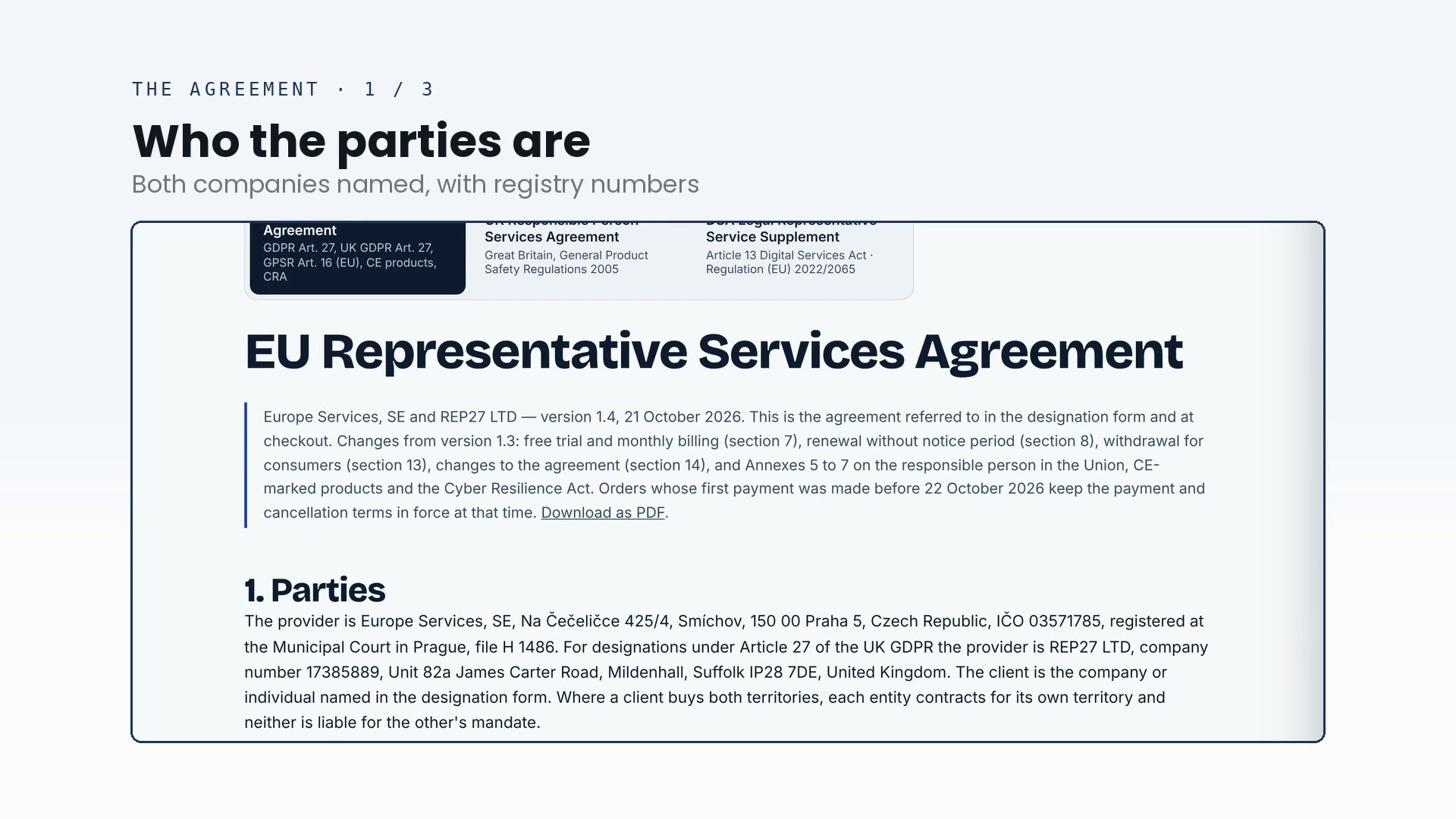
REP27 (Europe Services, SE, IČO 03571785, Praha 5) issues the written designation within 24 hours. Coverage extends to the entire EEA — all 27 EU Member States plus Norway, Iceland, and Liechtenstein — at no additional cost.
What a DPO is and when one is required
The Data Protection Officer under Article 37 GDPR is an internal role. It is mandatory for public authorities, for organisations carrying out large-scale systematic monitoring of individuals, and for organisations processing special categories of data on a large scale. The DPO monitors internal compliance, advises on data protection impact assessments, and liaises with supervisory authorities on matters relating to processing operations.
A DPO may be an employee or an external contractor, but the role is defined by its advisory and monitoring function inside the organisation. It does not replace the Article 27 representative, because the representative is the external contact point for authorities and data subjects — a structural requirement tied to the territorial scope of the regulation, not to the nature of the processing.
Why the two roles cannot replace each other
A non-EU company that appoints a DPO but not an Article 27 representative remains in breach of Article 27. The representative and the DPO can be the same legal entity only where the requirements of both roles are genuinely met, but the functions remain legally separate.
The penalty for failing to designate an Article 27 representative falls under Article 83(4): fines up to €10 million or 2% of total worldwide annual turnover, whichever is higher.
What the designation includes
The REP27 Standard plan (€490 for the first year, €390/year from renewal) covers unlimited forwarding of data subject and authority requests, an Article 30 records of processing activities file maintained by the representative, and a mailbox operating in 8 languages. Every designation comes with a signed designation letter, a verifiable certificate with QR code, and ready-to-use privacy-notice wording for Articles 13 and 14 in 8 languages. The Swiss Article 14 nFADP assessment is included with every paid EU plan.
For companies incorporated in 2026, the annual fee can be paid in 2 to 6 equal monthly instalments with no interest and no surcharge. The 7-day trial requires no payment card; the designation is publicly verifiable from day one.
Key points
- Article 27 GDPR requires non-EU controllers and processors to appoint a representative in the EU; the obligation arises from Article 3(2) and is separate from any DPO requirement.
- A Data Protection Officer under Article 37 is an internal compliance role; it does not satisfy the Article 27 obligation.
- Failing to designate an Article 27 representative exposes a company to fines up to €10 million or 2% of worldwide annual turnover under Article 83(4).
- REP27 issues the written designation within 24 hours, with EEA-wide coverage (27 EU countries plus Norway, Iceland, and Liechtenstein) included in every plan.
- Companies incorporated in 2026 can pay the annual fee in 2 to 6 interest-free monthly instalments; the designation is active and verifiable from the first day of the trial.
Frequently asked questions
What is a GDPR Article 27 representative?
A GDPR Article 27 representative is a natural or legal person established in the EU that a non-EU controller or processor designates in writing as the contact point for supervisory authorities and data subjects. The obligation applies when the organisation offers goods or services to, or monitors the behaviour of, individuals in the EU under Article 3(2) GDPR.
Does a DPO replace the Article 27 representative?
No. The Data Protection Officer under Article 37 GDPR is an internal advisory and monitoring role. It does not fulfil the external contact-point function required by Article 27. A non-EU company that appoints only a DPO remains in breach of Article 27.
What is the fine for not having an Article 27 representative?
Under Article 83(4) of Regulation (EU) 2016/679, the maximum fine for failing to designate an Article 27 representative is €10 million or 2% of total worldwide annual turnover, whichever is higher.
How quickly can a GDPR Article 27 representative be appointed?
REP27 (Europe Services, SE) issues the signed designation within 24 hours of order. The designation is publicly verifiable by QR code from day one, including during the 7-day trial period.
Which countries does one EU GDPR representative cover?
A single Article 27 designation covers the entire EEA: all 27 EU Member States plus Norway, Iceland, and Liechtenstein. REP27 includes this full EEA coverage in every plan at no additional cost.