REP27 · EUDR · Timber and furniture
Annex I · former EUTR · geolocation
Timber importers are the only group that already had a due diligence obligation before this regulation, and that is precisely why they are at risk. The EUTR was repealed, its system does not satisfy the EUDR, and the biggest single change is one the EUTR never asked for: geolocation of the plots where the wood was harvested. Add the cut-off date of 31 December 2020, an Annex I list that reaches furniture, panels, pulp and paper, and a filing duty that moved upstream in December 2025, and a compliant EUTR programme becomes a starting point rather than an answer.
Sawn woodPanelsFurniturePulp and paperCharcoal
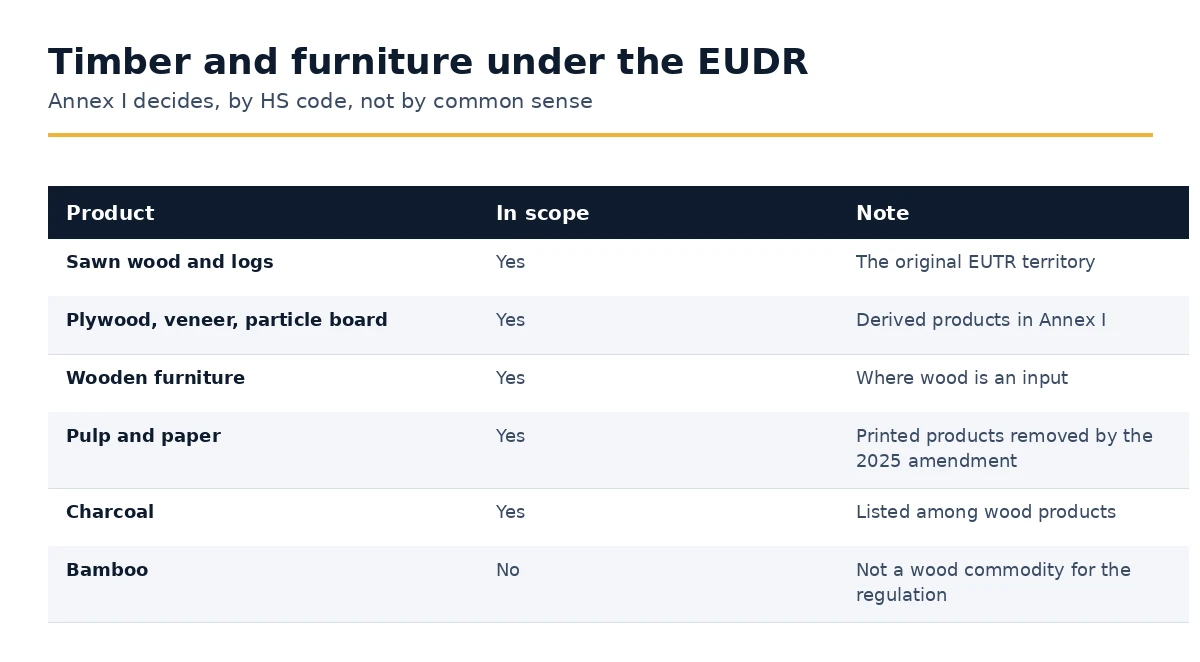
Annex I works by HS code, which is why intuition is a poor guide. Wooden furniture is in and bamboo is out, and the December 2025 amendment removed printed products from the list while a draft act in 2026 proposed further changes.
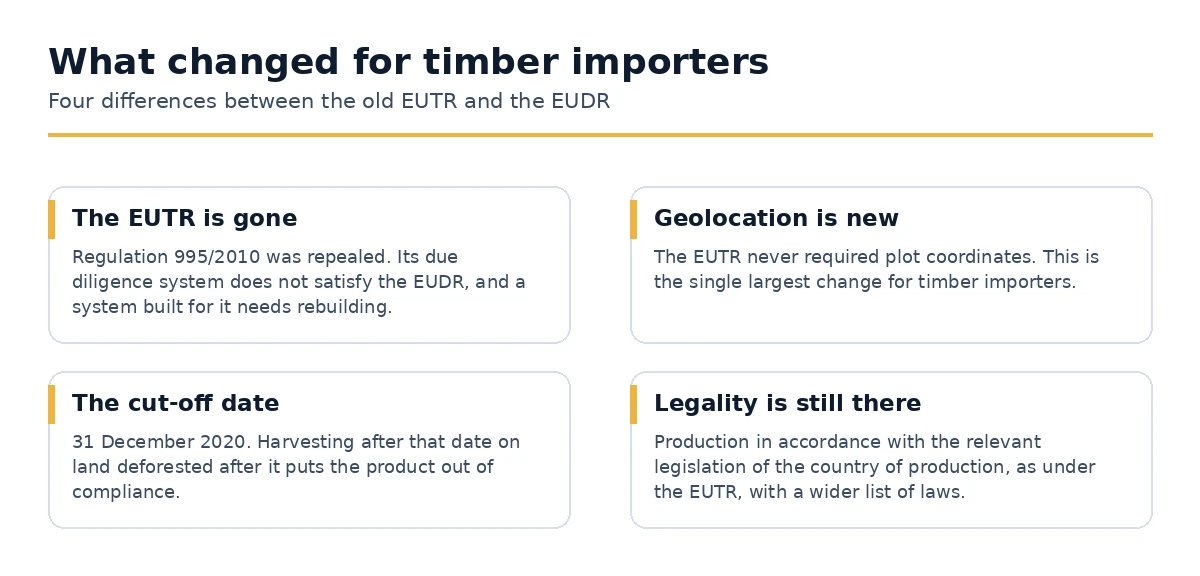
Years of documentation and known counterparties are genuine assets. The EUDR does not throw them away.
The legality of harvest under the country's own law survives into the EUDR, with a wider list of laws that includes labour, human rights and tax.
Plot coordinates for every consignment. This is the new build and it takes the longest.
Deforestation-free by reference to 31 December 2020, which the EUTR never assessed.
Against the Article 10 criteria, which are broader than the EUTR's and include the presence of forests in the area of production.
Statements in the Information System, and after the December 2025 amendment, the question of whether you file at all or pass on a reference number.
Furniture is where the regulation reaches companies that have never thought of themselves as timber operators, and where the chain is longest.
| Situation | Position under the EUDR |
|---|---|
| Importing finished furniture from outside the Union | You are the operator placing it on the market: full due diligence and a statement |
| Buying furniture from an EU importer | First downstream operator: keep and pass the reference number |
| Buying from an EU wholesaler who bought from the importer | Outside the obligations after the amendment |
| Assembling furniture in the Union from imported panels | The panel import carries the duty; your product is downstream of it |
| Selling furniture online into the Union from outside | Placing on the market, with the same duties as any importer |
The fourth row is the one that saves money. A European manufacturer buying panels that already carry a due diligence statement inherits a reference number rather than a filing obligation, which is exactly what the December 2025 amendment intended.
The easiest case: boundaries exist, often already digitised, and the harvest is documented.
Harder, closer to the coffee problem, with informal tenure and aggregation at a sawmill.
Treated differently, because material that has completed its lifecycle is handled separately in the regulation. Check the current position for your product.
A single sheet can contain material from many origins. Traceability has to reach every one of them.
A dataset that ties consignments to plots and survives an audit, kept current as suppliers change.
A country-level declaration from a supplier. It satisfied the EUTR in some cases and satisfies nothing here.
| Item | Position |
|---|---|
| Medium and large operators | 30 December 2026 |
| Micro and small enterprises | 30 June 2027 |
| Cut-off date | 31 December 2020 |
| Long rotation species | Harvested decades after planting, on land whose status was fixed long before the regulation |
| Stock in hand | Material already in your warehouse still needs its origin established when it is placed on the market |
The EUTR is repealed and its system does not carry over. Keep the supplier relationships and the legality work, add plot geolocation and the 2020 cut-off test, rebuild the risk assessment against Article 10, and check whether the December 2025 amendment leaves you filing at all: importers do, most downstream buyers now pass on a reference number instead. Furniture, panels, pulp and paper are all in Annex I; bamboo is not; printed products were removed. If you are outside the Union and place products on the market yourself, an Article 6 authorised representative can file and receive correspondence for you, with the liability staying where the regulation puts it.
Timber companies do not start from zero, and the fastest route is to treat this as a migration rather than a new build.
| What you have | What to do with it |
|---|---|
| Supplier due diligence files | Keep. They carry the legality work forward |
| Country risk assessments | Rebuild against Article 10 criteria, which are broader |
| Chain of custody certification | Keep as supporting evidence, not as a substitute |
| Supplier declarations at country level | Replace. Plot coordinates are the requirement now |
| Species and harvest documentation | Keep and extend with the cut-off date test |
| Internal procedures | Rewrite around the statement, the reference number and the five-year retention |
Done in that order, a functioning EUTR programme becomes an EUDR programme in months rather than in a panic. Done in the other order, teams rebuild things that never needed rebuilding while the geolocation gap stays open.
The EUTR is repealed and its system does not satisfy the EUDR. Keep the supplier work and the legality documentation, add plot geolocation and the 31 December 2020 cut-off test, and rebuild the risk assessment. Furniture, panels, pulp and paper are in Annex I; bamboo is not; printed products were removed in December 2025. Importers file; most downstream buyers now pass on a reference number instead. And if you place products on the Union market from outside it, an Article 6 authorised representative handles the filing and the correspondence while the liability stays with you.
The single question that predicts whether a supplier will still be usable in 2027. A concession holder should answer in days; a smallholder chain will need a programme, and knowing which you have is the point of asking now.
Harvesting rights, environmental permits, tax and labour compliance. The EUTR asked a narrower version of this, so most suppliers have part of the answer already and need to extend it.
Panels and pulp blend by design. Without segregation, one non-compliant plot contaminates a large volume, and the commercial loss is far larger than the compliance cost.
Timber sits in inventory and moves through several hands. Material placed on the market after your application date needs its origin established, and establishing it retroactively for wood bought in 2024 is the hardest version of this work. Decide now whether that stock will be sold before the date or documented, because the third option, hoping, is not one.
Some will refuse or be unable to provide plot coordinates. That is a commercial decision disguised as a compliance one: a supplier without geolocation cannot be used for the Union market after your date. Identify them this year, while there is time to qualify alternatives, rather than in the last quarter before application.
Solid wood is traceable in a way that sheet material is not, and this is where timber differs from every other commodity in the regulation.
| Product | Traceability difficulty | What helps |
|---|---|---|
| Logs and sawn wood | Low: one tree, one plot | Harvest records already exist |
| Plywood and veneer | Medium: layers from several sources | Batch segregation at the mill |
| Particle board and MDF | High: many origins in one sheet | Supplier-level mapping of the whole intake |
| Pulp and paper | Highest: continuous process | Mill-level control of every input stream |
A working EUTR programme is a head start and not an answer: keep the supplier files and the legality evidence, add plot geolocation and the 31 December 2020 cut-off test, rebuild the risk assessment against Article 10, and check whether the December 2025 amendment leaves you filing at all or simply passing on a reference number.
No. The EUTR was repealed and the EUDR requires plot geolocation, a cut-off date test and a statement in the Information System that the EUTR never had.
Yes, wooden furniture appears in Annex I among the derived wood products.
No. Bamboo is not one of the wood commodities for the purposes of the regulation.
Yes. Printed products, however, were removed from scope by the December 2025 amendment.
31 December 2020. Wood harvested from land deforested after that date is non-compliant.
Yes, coordinates of the plots of land where the wood was harvested. This is the largest change from the EUTR.
The operator that first places the product on the Union market. Downstream buyers generally keep and pass on the reference number instead.
Material that has completed its lifecycle is treated differently. Check the current position for your specific product and process.
Products are covered when placed on the market, so stock placed after the application date needs its origin established.
Compliance with the country of production's laws on harvesting rights, environment, forests, third-party rights, labour, human rights, tax and trade.
30 December 2026 for medium and large operators and traders, 30 June 2027 for micro and small enterprises.
No. Certification can support the risk assessment but does not replace due diligence, geolocation or the statement.
Set by Member States and include fines proportionate to environmental damage and the value of the products, confiscation and exclusion from public procurement.
Yes, under Article 6, with your data. The operator remains responsible for compliance.
No. One mandate covers the filing; the competent authority is that of the Member State concerned.
Five years, including suppliers, customers and reference numbers.
Yes. Printed products were removed in December 2025, and a draft act in 2026 proposed further changes to the annex.
Ask suppliers for plot coordinates on the largest volume line and see what comes back. That answer sets the whole timetable.
Related: the statement in detail · dates and scope
Europe Services, SE in Prague as your Article 6 authorised representative, submitting statements with your data and answering the competent authority.
Request this service