
Article 16 GPSR · textiles · EN 14682
Apparel sellers already know the fibre composition label. What arrived with the GPSR is a second, separate requirement: the manufacturer and an EU-established responsible person have to be identifiable on the product, its packaging or an accompanying document. The two are governed by different rules, printed for different reasons, and satisfying one has never satisfied the other. Then there is the part that actually generates recalls, which is not the fabric at all.
Swing tagSewn-in labelEN 14682Children's wearPrint on demandFibre composition
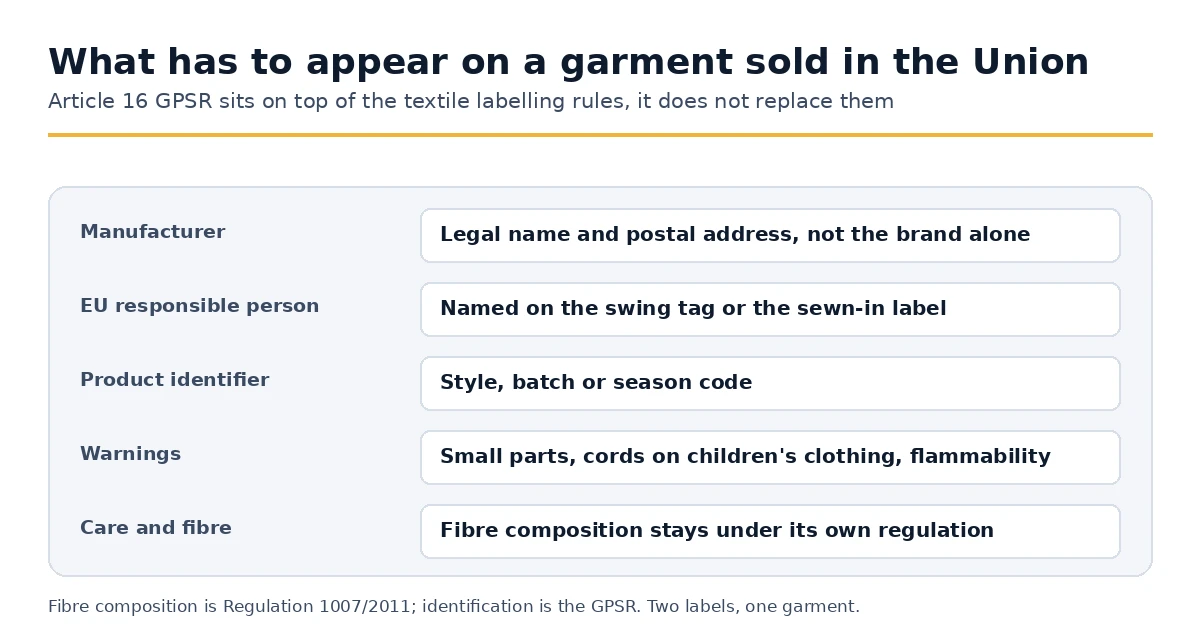
The fibre composition line is Regulation 1007/2011 and has been compulsory for years. The manufacturer and responsible person lines are new, come from the GPSR, and are the ones missing from almost every garment we are asked to review.
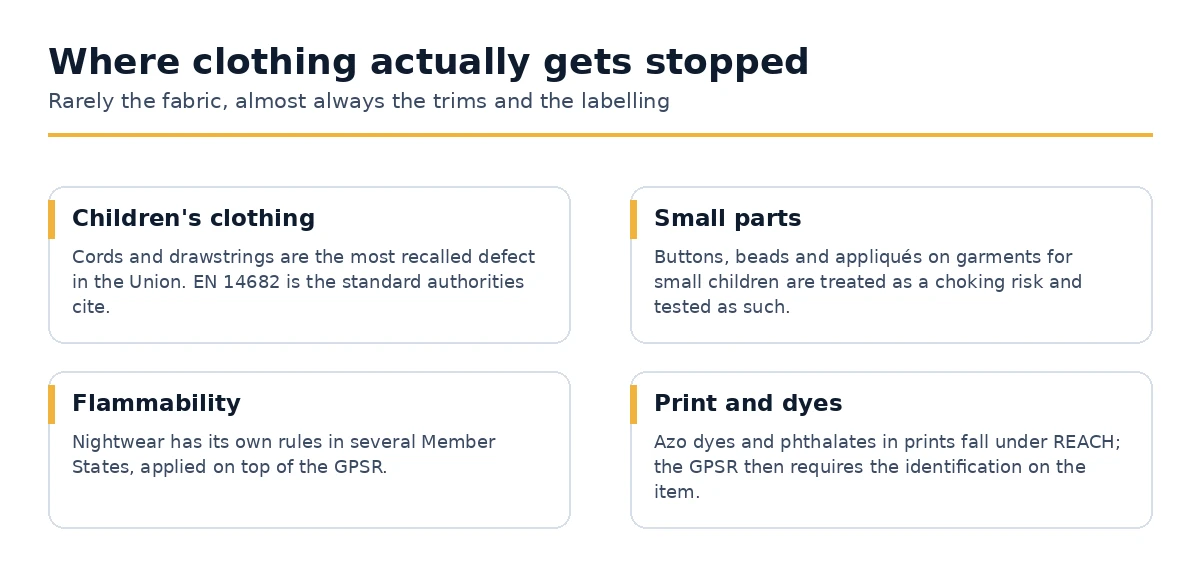
Fabric almost never fails. Cords, small parts, prints and labelling do, and three of those four are decisions made by whoever finishes the garment rather than by the mill.
| Feature | What applies | Practical rule |
|---|---|---|
| Cords and drawstrings | EN 14682, cited by authorities across the Union | No cords at the neck for children up to 7; length limits elsewhere |
| Small parts | Choking risk assessed as for toys | Buttons, beads and appliqués must resist a pull test |
| Nightwear | National flammability rules in several Member States | Check per market; the GPSR does not override them |
| Prints and dyes | REACH restrictions on azo dyes and phthalates | Ask the supplier for the test report, do not assume it exists |
| Identification | Article 16 GPSR | Manufacturer and EU responsible person on a durable label |
This is the case that has grown fastest and is understood least. If the garment carries your brand, you are the manufacturer for EU purposes, whoever printed it and wherever the blank came from.
Selling under your own name or trade mark makes you the manufacturer, with the technical documentation and the risk assessment that follow.
A fulfilment partner in the Union is a service provider. Unless it has signed a mandate accepting the Article 16 tasks, it is not your responsible person.
Ask the blanks supplier for the composition, the REACH statements and any test reports before you print, not after a customer complains.
An insert or an additional durable label added before the item is made available brings existing stock into line without a new print run.
Europe Services, SE with the Prague address, in a form that fits a swing tag, plus an ASCII fallback for print files that break on accented characters.
Signed within 24 hours, with a certificate carrying a code a marketplace, a customer or an inspector can check independently.
Standard safety wording for the markets you sell into, so one artwork can serve several countries.
Your risk assessment and supplier reports kept available to authorities for the ten years the regulation requires.
Requests from consumers and market surveillance authorities logged and forwarded the same working day, in eight languages.
Article 16 accepts four locations, in order of durability. For clothing the practical ranking is not the same as the legal one, because packaging is discarded within minutes of delivery.
| Location | Accepted | Practical verdict for apparel |
|---|---|---|
| Sewn-in label | Yes | Best: survives the life of the garment and any later inspection |
| Swing tag | Yes | Good at the point of sale, removed by the customer at home |
| Polybag or packaging | Yes | Acceptable, but discarded immediately after delivery |
| Accompanying insert | Yes | The rescue option for stock already produced |
| Website only | No | Treated as absent, however complete the page is |
Not on the invoice as a description, but as a statement you can put behind your own label if a market surveillance officer asks.
Azo dyes, phthalates in prints, nickel in metal trims. These are the substances actually tested when a garment is pulled.
Small parts pull tests and, where cords exist, conformity with EN 14682. Without them your risk assessment has nothing to rest on.
The manufacturer field wants a company with an address, not a trading name printed on a swing tag.
If the blank changes mid-season, the documentation changes with it. Record which batch corresponds to which report.
The legal requirement is identical everywhere. What differs is which field the platform puts in front of you and how quickly it blocks the offer.
| Channel | What it asks for | What happens if it is empty |
|---|---|---|
| Amazon | Responsible person, manufacturer, safety images | Offer suppressed, buy box lost |
| eBay EU sites | Same fields in the compliance section | Listing blocked on the EU sites |
| Etsy | Responsible person plus safety information per listing | Listing hidden from EU buyers |
| Shopify or your own store | Nothing automatic | Nothing, until an authority or a customer asks |
| Wholesale to EU retailers | Buyer's compliance questionnaire | The order does not happen |
A different blank, dye or trim is a different product for documentation purposes, even if the design is the same as last year.
Which delivery corresponds to which supplier statement. Without this, a recall cannot be limited to the affected run.
The label as printed, per market. Proving what was on the garment two years ago is otherwise impossible.
The responsible person does not change with the collection; only the underlying documentation does.
Apparel has the highest return rate of any category, and returned stock re-enters the market constantly. Each route has a different answer.
| Route | Obligation | Practical point |
|---|---|---|
| Returned and resold as new | Unchanged | The original identification must still be on the garment; check the label survived |
| Sold as B-grade or outlet | Unchanged | Being discounted has no effect on safety or identification duties |
| Repaired before resale | Yours, as the one placing it again | Substantial modification makes you responsible for the modified aspects |
| Donated or given as samples | Applies | Making available does not require payment |
| Sold for parts or materials | Outside, if stated clearly | Must be supplied explicitly as not for use as clothing |


No. Fibre composition comes from Regulation 1007/2011. Article 16 GPSR separately requires the manufacturer and an EU-established responsible person to be identifiable on the product.
On the product, its packaging, the parcel or an accompanying document. For garments a swing tag or a sewn-in label is the practical answer, because packaging is thrown away.
No. The information must travel with the garment in durable form. A website page is not a substitute and a QR code alone is treated as an absence.
Yes. The identification requirement applies to all consumer products. What changes with children's wear is the safety scrutiny, not the labelling duty.
The harmonised standard on cords and drawstrings in children's clothing. It is the standard authorities cite most often when a garment is withdrawn.
If the garment carries your brand, you are, whoever printed it. The printer is a service provider unless it has signed a mandate accepting the Article 16 tasks.
Yes, when sold in the course of a business. Vintage sold as antiques or items sold explicitly for repair are outside.
Yes. They are consumer products in their own right and need the same identification.
No. Since Brexit it is a third-country address for this purpose. The responsible person must be established in the Union.
Making available does not require payment, so promotional items are treated like sold ones.
You need a risk assessment proportionate to the product, and the supplier statements behind it. For a plain adult t-shirt this is short; for children's wear with trims it is not.
Yes. One appointment covers every reference and every European marketplace; there is no per-SKU fee.
Names and addresses are not translated. Warnings and safety instructions are, in the language of each country of sale.
That satisfies the manufacturer line only if it is a legal entity with a contactable address. It never satisfies the EU responsible person line, which requires establishment in the Union.
Ten years from the moment the garment is placed on the market, available to authorities on request. We hold a copy.
From €290 a year for the responsible person, €890 for the plan that also covers the Article 27 GDPR representative for your online store.
Related: the full label requirements · what falls under the GPSR
A signed Article 16 designation within 24 hours, the exact label wording for garments, and a certificate anyone can verify.
Appoint a responsible person