REP27 · EUDR · Due diligence statement
Articles 4 and 8 to 11 · Information System · reference number
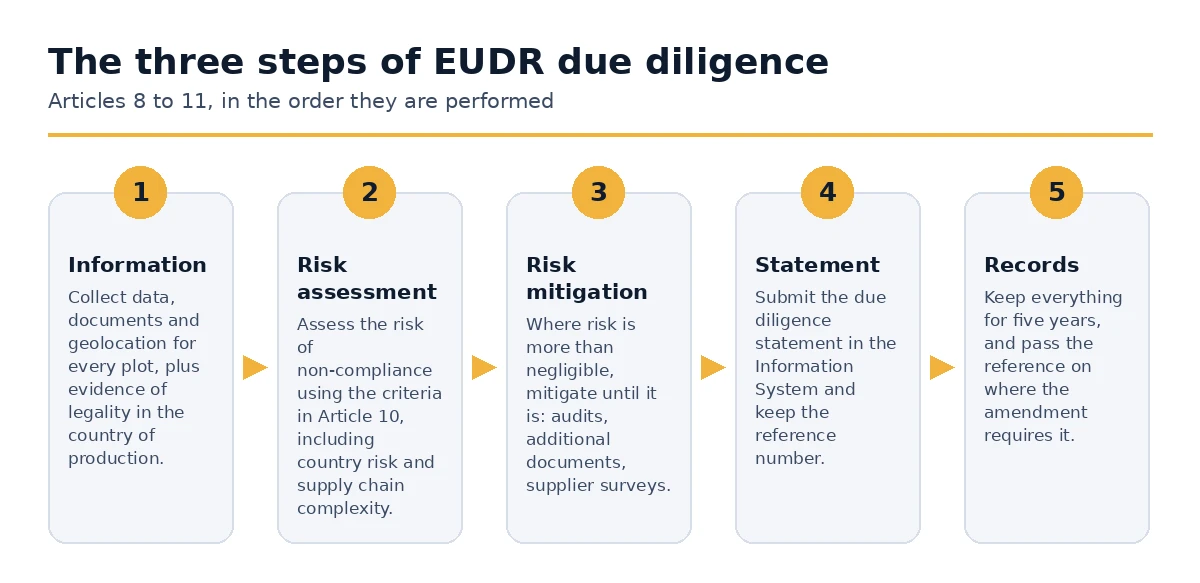
A due diligence statement is short. What sits behind it is not: geolocation for every plot, evidence of legality in the country of production, a risk assessment against the criteria in Article 10, and mitigation until the risk is negligible. Only then is the statement filed in the Information System, and only then does the reference number exist that the rest of your chain will ask for. This page works through the contents, the three steps and the question everyone asks first, which is whether they still have to file at all.
GeolocationLegalityRisk assessmentReference numberFive years
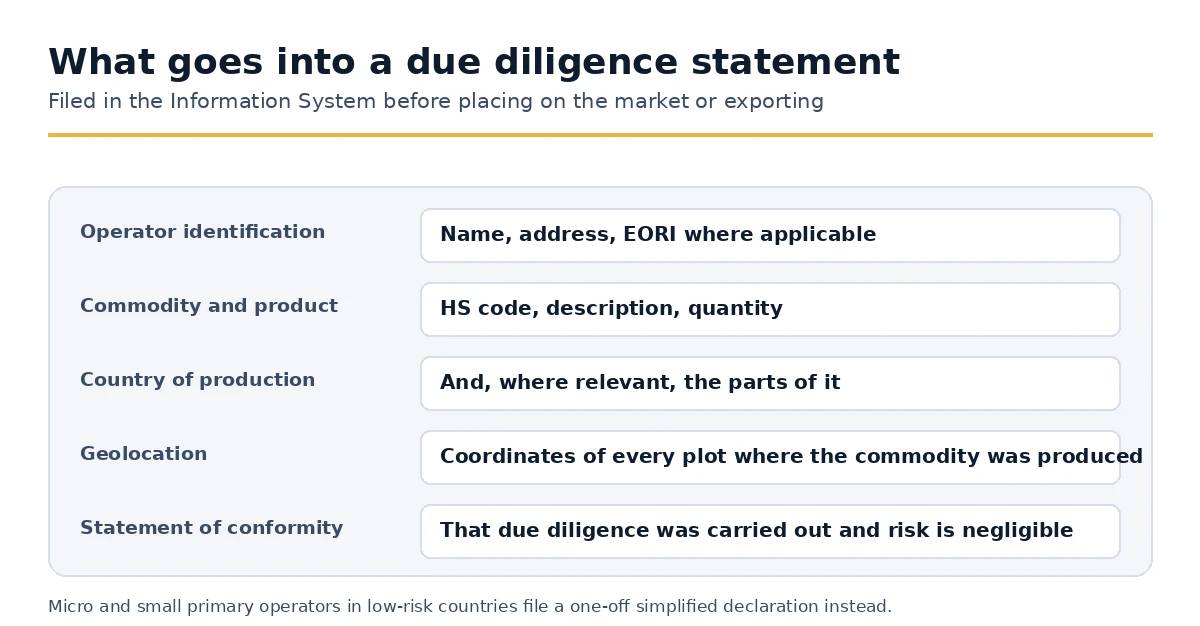
Five blocks, and the fourth is where projects live or die. Geolocation means coordinates of every plot of land where the commodity was produced, which for a coffee chain with thousands of smallholders is a fieldwork programme rather than a data entry task.
| Your position | Do you file? | What you do instead |
|---|---|---|
| Primary operator, medium or large | Yes | Full due diligence and a statement before placing on the market |
| Primary operator, micro or small in a low-risk country | A one-off simplified declaration | Updated only on a major change |
| First downstream operator | No | Collect the reference number and pass it on |
| Downstream buying from a downstream operator | No | Outside the obligations after the amendment |
| Non-SME downstream operator or trader | No | Register in the Information System |
| Exporter from the Union | Yes | The same duties apply on export |
Read your own row before spending anything. The December 2025 amendment is the most consequential thing that has happened to this regulation, and a large number of European companies that were preparing to file thousands of statements now file none.
Coordinates of the plots of land where the relevant commodity was produced, with polygons above a certain size and points permitted below it, depending on the commodity.
Your suppliers, and beyond them their suppliers. For long chains, this is the entire project.
Smallholder chains aggregate at a cooperative or a mill, and traceability to plot level often does not exist yet.
A dataset that ties every batch to plots, kept current, with the ability to answer which plots supplied a given consignment.
Start with the volume that matters. A pilot on one origin teaches more in a month than a year of planning across all of them.
The identifier returned by the Information System when a statement is filed. It is the object that travels down the chain.
The first downstream operator, which collects it and passes it on. After the amendment this replaces most downstream filings.
In your commercial documentation, so that a customer can prove the chain without repeating your due diligence.
A certificate of compliance. It shows a statement exists, not that an authority has checked it.
Five years, with the rest of the records.
An authorised representative under Article 6, filing with your data, which is where our service fits.
Competent authorities carry out checks on operators and traders, with the intensity varying by country risk classification. Knowing what they look at shapes what you keep.
| Checked | What they want to see |
|---|---|
| The statement | Filed before placing on the market, with the correct commodity and quantity |
| Geolocation | Plot data that matches the consignment, not a country-level approximation |
| Legality evidence | Documents on land use rights, environmental and labour law, and taxes in the country of production |
| Risk assessment | Written, against the Article 10 criteria, and dated before the statement |
| Mitigation | Evidence that risk was reduced to negligible, where it was not negligible to start with |
| Records | Suppliers, customers and reference numbers, kept for five years |
The statement is five blocks of data and the last step of a long project. Geolocation for every plot, evidence of legality, a written risk assessment, mitigation where needed, then filing in the Information System and keeping the reference number for five years. After the December 2025 amendment most downstream companies no longer file at all, so check your own row before building anything. If you are a primary operator or an exporter outside the Union, an Article 6 authorised representative can file for you and receive what comes back, while the due diligence itself stays yours.
Most failures here are data failures rather than legal ones. A structure that survives an audit has these six objects in it, connected.
| Object | What it holds | Why it matters |
|---|---|---|
| Plot | Coordinates, area, country, region, owner or holder | The unit the regulation asks about |
| Legality evidence | Documents per plot or per origin, with dates and issuers | Half the definition of compliant |
| Batch | Which plots contributed, in what proportion | The link nobody has until they build it |
| Consignment | Batches shipped together, with quantity and HS code | The object the statement describes |
| Risk assessment | Written, dated, against Article 10 criteria | What an authority asks to see first |
| Statement and reference | Filing date, reference number, who filed | What travels down the chain |
The third row is where projects break. Companies map plots and file statements without ever building the link between them, and the first authority check asks precisely that question: which plots supplied this consignment?
Five blocks in the statement, three steps behind it, one reference number that travels. Geolocation and legality evidence are the work; the filing is the last ten minutes. After the December 2025 amendment most downstream companies file nothing and simply pass on a reference number, so establish your position before building anything. If you place products on the market from outside the Union, an Article 6 authorised representative can file with your data and receive what comes back, while the due diligence and the liability stay with you.
Accepted under the old timber rules in some cases, and worthless here. The regulation asks which plots, not which country.
An unverified dataset fails the first check and cannot be repaired retroactively for consignments already shipped.
The dates are visible. An assessment dated after the filing tells an authority exactly what happened.
It supports evidence and replaces nothing. The statement is still yours to make.
The commonest data failure, and the one an authority tests first.
Two have happened and neither moved the cut-off date. The status of your supply base was fixed in 2020.
Checks are risk-based and documentary before they are physical, and the sequence is predictable enough to prepare for.
| Stage | What is asked | What to have ready |
|---|---|---|
| Selection | Nothing: you are selected by risk criteria | Nothing you can influence |
| Document request | The statement, the risk assessment, the plot data | All three, dated in the right order |
| Traceability test | Which plots supplied a named consignment | The batch to plot link |
| Legality test | Evidence per origin | Documents, with issuers and dates |
| Follow-up | Explanation of any gap | A named person who can answer within the deadline |
One of the quieter simplifications, and one that changes the workload by an order of magnitude for high-frequency importers.
| Approach | When it fits | What it requires |
|---|---|---|
| One statement per consignment | Low volume, varied origins | Plot data per shipment, filed before each placing |
| An annual statement | Stable supply base, repeated origins | The same due diligence, covering the period, kept current |
| Simplified declaration | Micro and small primary operators in low-risk countries | One filing, updated only on a major change |
Check which is available for your commodity and position before designing a system around per-consignment filing. Teams have built pipelines for thousands of statements that the amended rules would have reduced to a handful.
The statement is the last step of a project whose real content is plot geolocation and evidence of legality, filed in the Information System by whoever first places the product on the Union market, producing a reference number that the first downstream buyer keeps and passes on and that everyone further down no longer needs at all.

A statement filed in the Information System declaring that due diligence was carried out and that the risk of non-compliance is negligible, before products are placed on the market or exported.
Operator identification, commodity and product with HS code and quantity, country of production, geolocation of the plots, and the statement of conformity.
For full due diligence, yes. Micro and small primary operators in low-risk countries may use a simplified declaration with postal addresses in defined cases.
Collecting information, assessing risk against Article 10 criteria, and mitigating risk until it is negligible.
Primary operators placing products on the market, and exporters. Most downstream operators no longer file their own statements.
Collects the reference number of the primary operator's statement and passes it on, without filing its own.
The amendment took those companies out of the obligations altogether.
The identifier returned by the Information System when a statement is filed, which travels down the supply chain.
Five years, including supplier and customer identities and the reference numbers.
An annual statement is possible in defined cases rather than one per consignment. Check the current rules for your commodity.
31 December 2020. Land deforested after that date makes products from it non-compliant.
Production in accordance with the relevant legislation of the country of production: land use rights, environmental protection, forest rules, third parties' rights, labour, human rights, tax and trade.
Yes, under Article 6, with your data. Responsibility for compliance stays with the operator.
Competent authorities in the Member States, with check rates linked to country risk classification.
Set by Member States, including fines proportionate to environmental damage and the value of the products, and confiscation.
It was reworked after the December 2025 amendment and access was limited during the rebuild. Check its current state before planning.
30 December 2026 for medium and large operators and traders, 30 June 2027 for micro and small enterprises.
Map plots for your largest origin. Geolocation has the longest lead time and everything else depends on it.
Related: the Article 6 mandate · dates and commodities
Europe Services, SE in Prague as your Article 6 authorised representative, submitting statements in the Information System and returning the reference numbers your chain needs.
Request this service