REP27 · EUDR · Coffee and cocoa
Annex I · smallholders · traceability
Coffee and cocoa are the two commodities where the regulation meets its hardest case: millions of smallholders, aggregation at cooperatives and mills, and supply chains that have never needed traceability to plot level. The rules are the same as for any other commodity in Annex I. The work is not, and pretending otherwise helps nobody. This page maps the chain role by role, shows where the filing duty actually lands after the December 2025 amendment, and sets out what a European importer should be doing now.
Green coffeeRoastedCocoa beansChocolateSmallholders
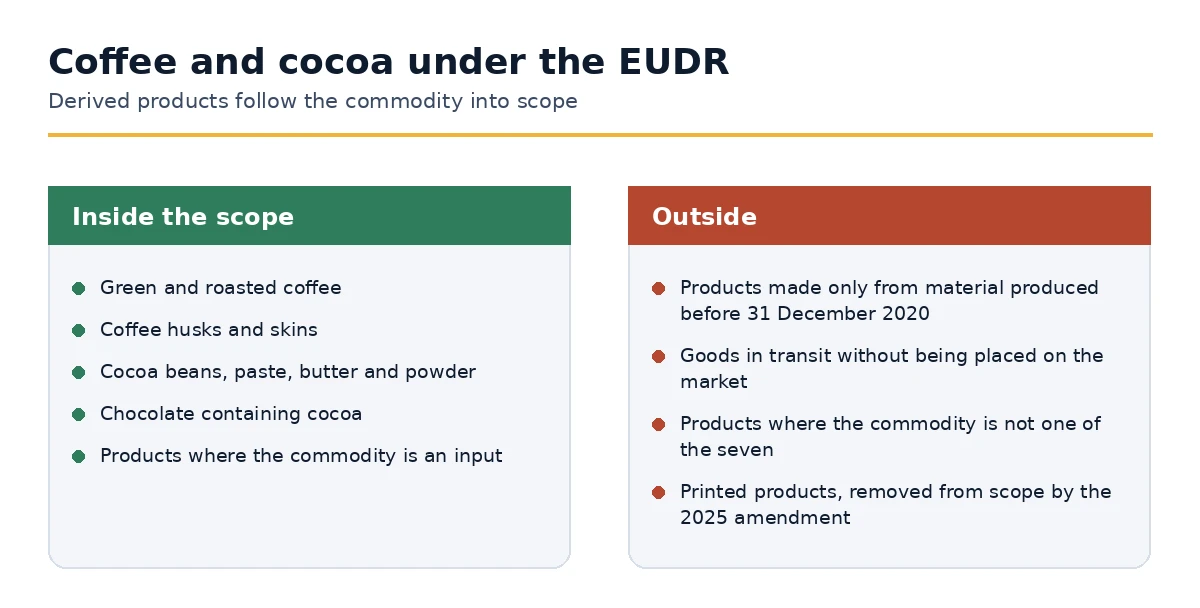
Derived products follow the commodity. Chocolate containing cocoa is in scope, roasted coffee is in scope, and a company that thought it bought a finished food product rather than a commodity discovers it is an operator.
A single container of green coffee can aggregate deliveries from hundreds of farms. Every one of those plots needs coordinates.
Cooperatives and washing stations mix lots by design. Traceability upstream of that point often does not exist and has to be built.
Coordinates collected once, by phone, in a field, with no verification, produce a dataset that fails the first check. Verification matters as much as collection.
Land use rights in many origins are informal. Evidence of legality is a separate exercise from mapping and often harder.
Start with one origin and one cooperative, prove the pipeline end to end, then scale. Programmes that try every origin at once stall in year one.
In practice the buyer, directly or through price. Pretending the cost sits with the grower is how programmes fail quietly.
| Question | What a good answer sounds like |
|---|---|
| Can you provide plot geolocation for the volume we buy? | Yes, with a dataset and a method, not a promise |
| How is it verified? | Field verification or satellite cross-check, with a sample rate |
| How do you keep lots separate? | A physical and documentary segregation at the aggregation point |
| What legality documents exist? | Land tenure, permits, tax and labour compliance, per origin |
| What happens if a plot is non-compliant? | Exclusion from the lot, not a blended average |
| Who files the statement? | Usually the EU importer, with the exporter supplying the data |
These six questions separate exporters who have done the work from exporters who will discover the requirement in late 2026. Asking them now costs a meeting; asking them in December costs a season.
An exporter or a producer group outside the Union that places products on the market itself and needs someone in the Union to file and to receive correspondence.
A company with a December 2026 date that wants the filing handled while its own team works on plot data.
A roaster buying from an EU importer: after the amendment, there is nothing to file.
Anyone without geolocation. The mandate covers the last step, not the fieldwork.
Moves the liability. The operator remains responsible for compliance under Article 6.
For most coffee and cocoa companies the money is better spent on traceability first, and on the mandate afterwards.
| Item | Position |
|---|---|
| Application, medium and large | 30 December 2026 |
| Application, micro and small | 30 June 2027 |
| Cut-off date | 31 December 2020, unchanged through both postponements |
| Harvest cycles before the date | Coffee and cocoa harvested from land deforested after the cut-off remain non-compliant whenever they arrive |
| Existing certification | Helps with evidence, does not substitute for due diligence or the statement |
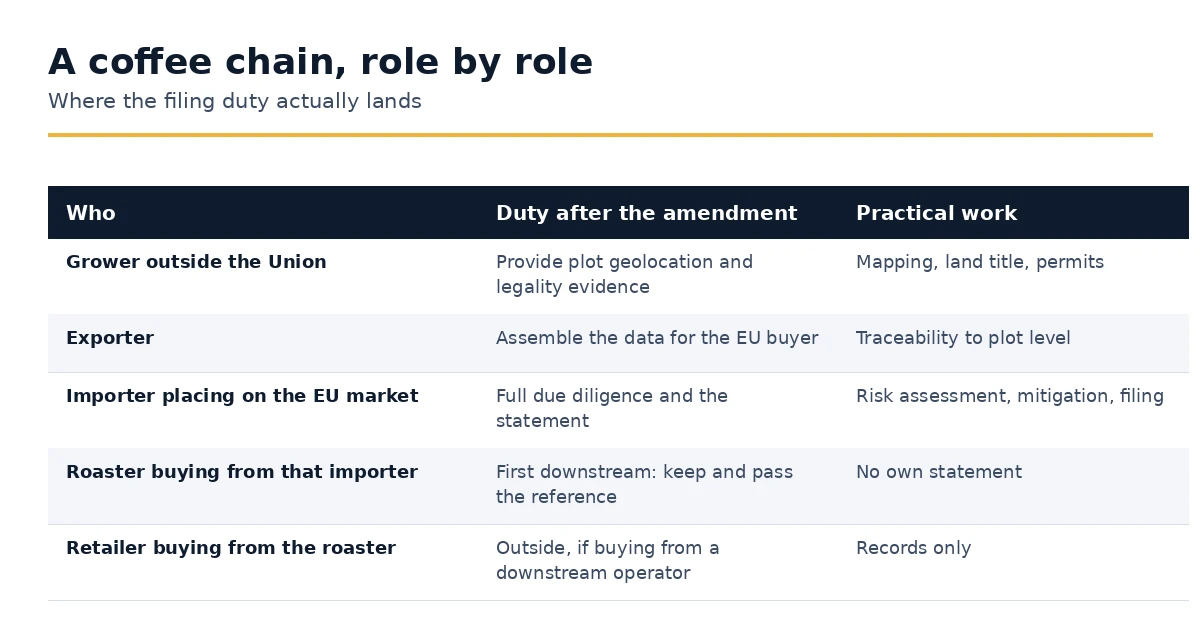
Coffee and cocoa are in scope, and so are the products made from them, including chocolate and roasted coffee. The filing duty sits with the operator placing the goods on the Union market; the first downstream buyer keeps and passes the reference number; everyone further down is outside after the amendment. The real work is plot geolocation and legality evidence in origin, and it is a fieldwork programme rather than a compliance document. Start with one origin, prove the chain, then scale, and add an Article 6 representative when the filing is the part you need help with.
Nobody publishes these numbers either, so here is the shape of the spend rather than a false precision.
| Line | Where it lands |
|---|---|
| Plot mapping in origin | The largest line by far, per farmer, per season, usually borne by the buyer |
| Verification of coordinates | Sampling, satellite cross-checks, field visits |
| Legality documentation | Per origin, harder where tenure is informal |
| Segregation at the mill or cooperative | Physical changes and lost blending flexibility |
| Systems | Connecting plots to batches to consignments |
| Filing and correspondence | The smallest line, and the only one we sell |
We put our own service at the bottom deliberately. Anyone selling an EUDR solution that starts with the filing is selling you the last ten minutes of a two-year programme.
Coffee, cocoa and the products made from them are in scope, including roasted coffee and chocolate. The importer placing them on the Union market files; the first downstream buyer keeps and passes the reference number; the rest of the chain is outside after the December 2025 amendment. The real work is plot geolocation and legality evidence at origin, and because the cut-off is 31 December 2020 and these are perennial crops, the compliance status of the land was fixed long before anyone asked. Start with one origin, prove it end to end, and bring in an Article 6 representative when filing is the part you need handled.
You are the operator placing them on the market: full due diligence, geolocation, risk assessment and a statement before the goods enter free circulation. This is the heaviest position in the chain and it is where most roasters sit.
You are the first downstream operator. Collect the reference number, keep it for five years and pass it on. No statement of your own, which is the single biggest relief the December 2025 amendment delivered.
Buying from a downstream operator puts you outside the obligations. Keep records of who supplied you and whom you supplied, and nothing more.
Ask your supplier for the reference number in writing, at the point of purchase. Retrofitting that request onto shipments already received is the administrative pain of 2027.
Three questions, in writing, at the point of purchase. They take a line in an email and they settle your position for five years.
| Ask | Why |
|---|---|
| The due diligence statement reference number | It is what you keep and pass on as first downstream operator |
| Whether they filed as the primary operator | Confirms the chain begins where you think it does |
| Confirmation the volume is covered | A reference for a different consignment protects nothing |
Traceability programmes fail when the European buyer treats them as a supplier obligation. These four inputs are what make them work.
Per farmer and per season, not a one-off pilot grant.
What format, what accuracy, what verification. Without it every cooperative invents its own.
A grower asked to map without a purchase commitment reasonably declines.
Exclusion of a plot cannot mean exclusion of a family with no notice. Decide the policy before it is tested.
Coffee, cocoa and everything made from them are in scope; the importer placing them on the Union market files the statement; the first downstream buyer keeps the reference number; and because the cut-off date is 31 December 2020 and these are perennial crops, the compliance status of every plot was decided years before the regulation applies.
No. A consignment containing material from a non-compliant plot is non-compliant, and averaging across a blend is exactly what the regulation was written to stop. The practical consequence is physical: segregation at the washing station, the mill or the warehouse, with documentation that survives a check. Companies that treat this as a paperwork question discover during the first audit that the paperwork describes a blend nobody separated.
Ask to see it before relying on it. Existing datasets are often a single point per farmer rather than a plot boundary, collected years ago, unverified and unlinked to deliveries. Each of those four gaps is fixable, and each takes a season. Knowing which of them you have is worth more than any project plan written without looking.
Yes. Coffee and its derived products, including roasted coffee and husks and skins, appear in Annex I.
Yes, where it contains cocoa. Derived products follow the commodity into scope.
The operator that first places the product on the Union market, typically the importer. Exporters from the Union file on export.
Generally not after the December 2025 amendment. A first downstream operator collects and passes on the reference number.
No, where they buy from a downstream operator. The amendment took them out of the obligations.
Yes, for full due diligence: coordinates of the plots where the commodity was produced, with polygons above a size threshold.
By building traceability to the plot upstream of the washing station or cooperative, which is the core of any credible programme.
No. Certification can support evidence but does not replace due diligence, the risk assessment or the statement.
31 December 2020. Land deforested after it makes the commodity non-compliant, whenever it is harvested or shipped.
A non-compliant plot contaminates the lot. Segregation at the aggregation point is what protects the volume.
It verifies deforestation status; it does not establish which plots supplied a consignment. Both are needed.
30 December 2026 for medium and large operators and traders, 30 June 2027 for micro and small enterprises.
Only if you are the operator placing the goods on the market or exporting, and you want the filing and correspondence handled in the Union.
No. It files with your data and receives what comes back. The fieldwork stays with your supply chain team.
Documents showing production complied with the country's laws on land use, environment, forests, third-party rights, labour, human rights, tax and trade.
Set by Member States, including fines proportionate to environmental damage and product value, confiscation and exclusion from procurement.
Five years, including suppliers, customers and reference numbers.
Pick the origin with the largest volume and map it end to end. It teaches more than a plan covering everything.
Related: the statement in detail · the Article 6 mandate
Europe Services, SE in Prague as your Article 6 authorised representative, submitting statements with your data while your team builds the plot dataset.
Request this service