REP27 · EUDR · Dates and scope
Regulation 2023/1115 · amended by 2025/2650 · Annex I
This regulation has been postponed twice and amended once, which has produced more confusion than any other file in European product law. The dates that apply now were set by Regulation (EU) 2025/2650, published on 23 December 2025: 30 December 2026 for medium and large operators and traders, 30 June 2027 for micro and small enterprises. The cut-off date has never moved. This page sets out the commodities, the dates, what the amendment changed and, honestly, which parts are still in flux.
30 Dec 202630 Jun 202731 Dec 2020Seven commoditiesAnnex I
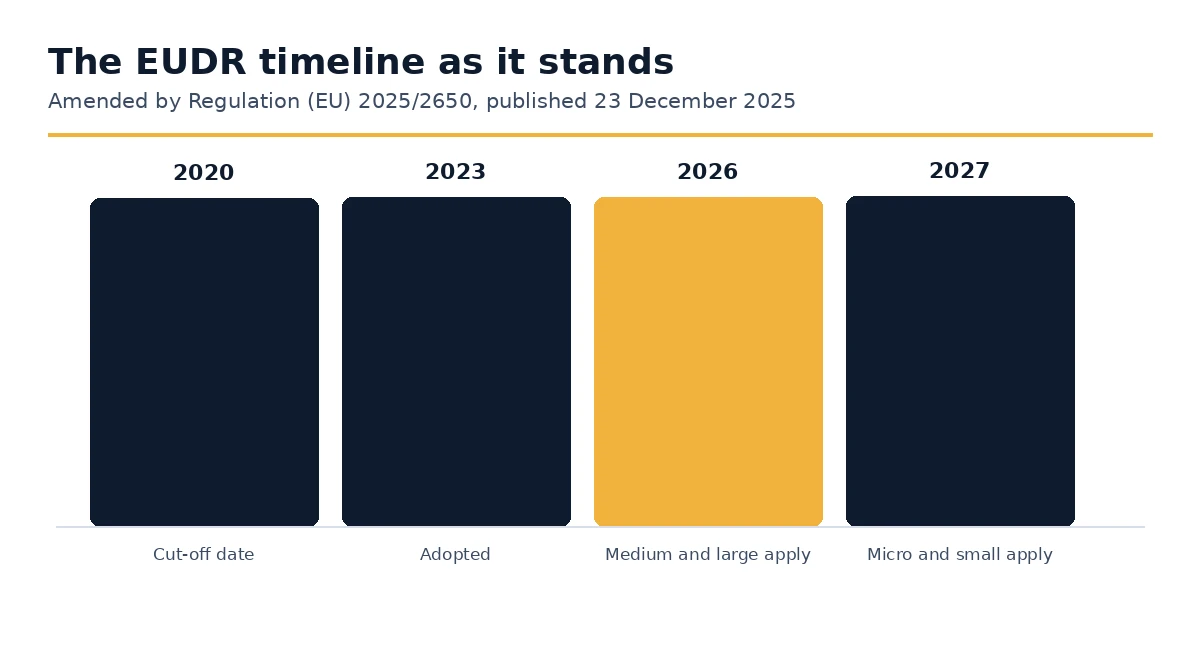
The first bar is the one that does not move. Everything else has shifted twice, and the cut-off date of 31 December 2020 has stayed exactly where it was in the original text.
| Change | Effect |
|---|---|
| Application postponed by one year | 30 December 2026 and 30 June 2027 |
| Downstream operators defined | Only the first downstream operator keeps and passes the reference number |
| Downstream buying from downstream | Outside the obligations entirely |
| Non-SME downstream operators and traders | Register in the Information System without filing statements |
| Micro and small primary operators in low-risk countries | A one-off simplified declaration, with postal addresses permitted in defined cases |
| Printed products | Removed from scope |
| Record keeping | All operators keep supplier and customer data for five years |
| Simplification review | The Commission to report, with a possible further legislative proposal |
If you built a compliance programme before December 2025, this table is your review list. The obligations were not weakened for the companies at the top of the chain; they were concentrated there, and removed from most of the companies below.
31 December 2020. Products must be deforestation-free by reference to it, and no postponement has touched it.
Coordinates of the plots, for full due diligence. It remains the core requirement and the longest piece of work.
Production in accordance with the country of production's laws, across land use, environment, labour, human rights, tax and trade.
Information, risk assessment, risk mitigation, before any statement is filed.
The regulation covers products placed on the Union market and products exported from it.
Set by Member States, proportionate to environmental damage and product value, including confiscation and exclusion from public procurement.
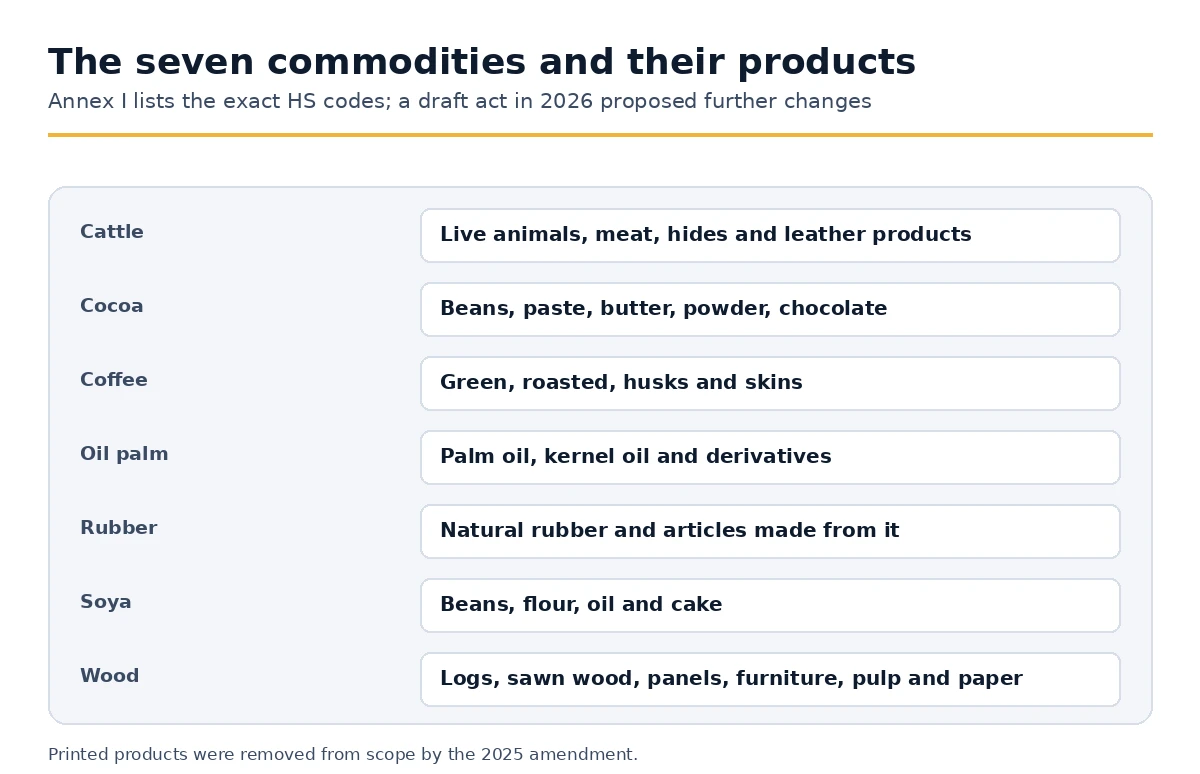
A draft act in 2026 proposed removing some items and adding others. Until it is adopted, Annex I as amended in December 2025 is what applies.
Risk classification affects check rates and which simplified regime applies. It has been contested, so verify the current position rather than assuming.
Reworked after the amendment, with access limited during the rebuild. Plan a go-live against its real state, not against a date.
Commission guidance and delegated acts continue to appear and change practical detail.
The simplification review may be accompanied by one. It has happened twice; assuming it will happen again is a gamble.
Say which parts are settled and which are not, on every page, rather than presenting a moving file as fixed.
| Question | If yes |
|---|---|
| Do you place one of the seven commodities, or a product in Annex I, on the Union market? | You are an operator, and the duties follow your size and position |
| Are you the first to place it on the market? | Full due diligence and a statement, from your application date |
| Do you buy from an operator and place the resulting product on the market? | First downstream: keep and pass the reference number |
| Do you buy from a downstream operator? | Outside the obligations after the amendment |
| Are you established outside the Union and place products yourself? | An Article 6 authorised representative can file and receive correspondence for you |
| Were you micro or small on 31 December 2024? | Your date is 30 June 2027 |
Seven commodities and the products derived from them, a cut-off date of 31 December 2020 that has never moved, and application from 30 December 2026 for medium and large operators and 30 June 2027 for micro and small. The December 2025 amendment concentrated the filing duty on whoever places the product on the market first and released most downstream companies from filing at all. Geolocation and legality evidence remain the real work. Scope, country benchmarking and the Information System are still moving, and any page telling you otherwise, including a competitor's, is presenting a live file as a settled one.
The history is worth knowing, because it explains why so many companies are unprepared and why the third postponement is a bad thing to plan around.
| When | What happened |
|---|---|
| June 2023 | Regulation (EU) 2023/1115 adopted, with application from 30 December 2024 |
| December 2024 | First postponement by one year, to 30 December 2025 for large and medium operators |
| December 2025 | Second postponement plus targeted simplification, published on 23 December, moving application to 30 December 2026 |
| By 30 April 2026 | A Commission simplification review, which may be accompanied by a further proposal |
| Throughout | The cut-off date of 31 December 2020 unchanged |
The lesson companies drew was that the deadline always moves. The lesson available in the text is different: each postponement bought preparation time without repairing a single hectare, because the cut-off is fixed in the past. A supply base that fails the 2020 test fails it in 2027 exactly as it did in 2024.
Seven commodities and their derived products, a cut-off date of 31 December 2020 that has never moved, application from 30 December 2026 for medium and large operators and traders and 30 June 2027 for micro and small enterprises. The December 2025 amendment concentrated the filing duty on whoever first places the product on the market and released most downstream companies. Geolocation and legality evidence remain the work. Product scope, country benchmarking and the Information System are still in motion, and we would rather say so than present a moving file as settled.
Primary operator, first downstream, further downstream or trader. This decides everything else and takes an hour.
30 December 2026 or 30 June 2027, based on your size as of 31 December 2024.
Not by product name, and with the December 2025 removals applied.
The answer sets your real timetable better than any project plan.
Against Article 10 criteria, before you need it under pressure.
Test access when it is fully restored rather than assuming it will work on the day.
Regulation (EU) 2023/1115 and the amending Regulation (EU) 2025/2650 are the only authoritative sources for dates and scope, and they are freely available.
Guidance, delegated acts, the Information System status and the simplification review as it develops.
National implementation differs in practice, particularly on checks and penalties.
Including this one. We date our pages and say what is moving, but a live regulatory file deserves a primary source before a commercial decision.
Member States set the penalties, which means the exposure differs by country in a way that is easy to underestimate.
| Measure | What the regulation requires of Member States |
|---|---|
| Fines | Proportionate to environmental damage and the value of the products, with a maximum set as a percentage of Union turnover |
| Confiscation | Of the products concerned and of revenues gained from them |
| Exclusion | Temporary exclusion from public procurement and from access to public funding |
| Prohibition | Temporary prohibition from placing products on the market in serious or repeated cases |
| Publication | Of the infringement and the penalty, which is often the part that hurts commercially |
Seven commodities, a cut-off date of 31 December 2020 that has survived two postponements untouched, application from 30 December 2026 for medium and large operators and 30 June 2027 for micro and small, with the filing duty concentrated on whoever places the product on the market first and lifted from most of the companies below them.
This single question separates full due diligence from keeping a reference number, and after the December 2025 amendment it is the most valuable hour of analysis available in this regulation. An importer buying directly from origin is a primary operator with the whole obligation. A manufacturer buying panels or beans from an EU importer is downstream and files nothing. Companies have discovered, after months of preparation, that they were in the second group all along.
That date, not today's headcount, decides whether your application date is 30 December 2026 or 30 June 2027. A company that has grown since then keeps the earlier classification for this purpose, which is generous and easy to miss. Establish it from your accounts rather than from memory, and write the conclusion down with the evidence.

From 30 December 2026 for medium and large operators and traders, and from 30 June 2027 for micro and small enterprises.
Regulation (EU) 2025/2650, published in the Official Journal on 23 December 2025.
No. It remains 31 December 2020 and has survived both postponements.
Cattle, cocoa, coffee, oil palm, rubber, soya and wood, with the derived products listed in Annex I.
No. They were removed by the December 2025 amendment.
A company that places on the market products manufactured from products already placed under a due diligence statement or simplified declaration.
Generally no. The first downstream operator keeps and passes on the reference number; those buying from downstream operators are outside.
A one-off declaration for micro and small primary operators in low-risk countries, updated only on a major change.
They register in the Information System without submitting their own statements.
Five years, including the identities of suppliers and of the operators or traders supplied.
Yes. It applies to products placed on the Union market and to products exported from it.
Set by Member States, including fines proportionate to environmental damage and product value, confiscation and exclusion from public procurement.
It has been contested. Because classification affects check rates and the simplified regime, verify the current position before relying on it.
It was reworked after the amendment and access was limited during the rebuild. Check its state before planning a go-live.
Yes. A draft act in 2026 proposed further changes, and the Commission's simplification review may bring more.
We would not plan on it. Two postponements have not touched the cut-off date, so the compliance status of your supply base is already fixed.
Only if you place products on the Union market or export from it and want the filing and correspondence handled inside the Union.
Establish which row of the roles table you are in. A large number of companies that were preparing to file now have nothing to file.
Related: the Article 6 mandate · the statement in detail
Europe Services, SE in Prague as your Article 6 authorised representative, filing with your data and telling you plainly which parts of this regulation are still moving.
Request this service