
REP27 · EUDR · Authorised representative
Regulation (EU) 2023/1115 · amended by 2025/2650 · article 6
Article 6 of the deforestation regulation lets an operator or a trader mandate an authorised representative established in the Union to submit due diligence statements on its behalf. It is a genuine convenience for a company with no presence in Europe, and it is not a transfer of responsibility: the operator remains liable for compliance, and the amended regulation is explicit about it. This page sets out what the mandate does, the dates as they stand after the December 2025 amendment, and who actually has to file now.
Article 630 Dec 202630 Jun 2027Information SystemReference number
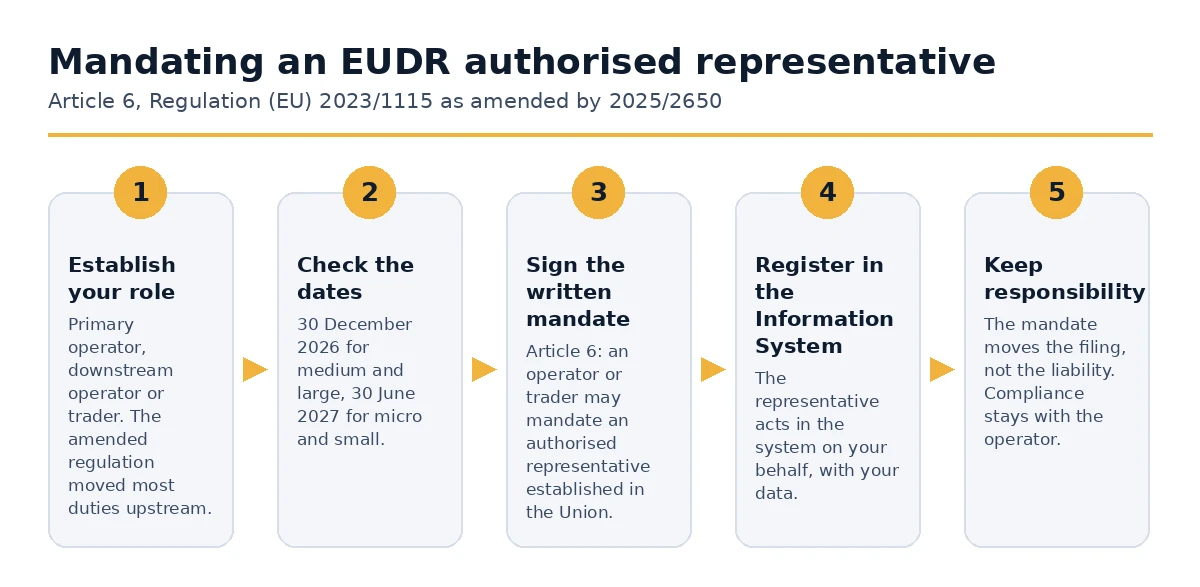
Step five is the one to read twice. The mandate moves the filing and the correspondence; it does not move the liability. An operator that mandates a representative and then supplies bad geolocation data is still the non-compliant party.
| Who | Applies from | Source |
|---|---|---|
| Medium and large operators and traders | 30 December 2026 | Regulation (EU) 2025/2650 |
| Micro and small enterprises | 30 June 2027 | Same, for those already micro or small on 31 December 2024 |
| Cut-off date for deforestation | 31 December 2020 | Unchanged since the original regulation |
| Commission simplification review | By 30 April 2026 | May be accompanied by a further legislative proposal |
Two postponements in two years have taught the market a bad habit: assuming a third. The core obligations have never been weakened, only the dates and the distribution of the filing duty, and the cut-off date of 31 December 2020 has never moved. A supply chain that was non-compliant in 2023 is still non-compliant, whatever the application date says.
Submits due diligence statements in your name, with the data you provide, and returns the reference numbers you need to pass down the chain.
Questions from the competent authority of the Member State, logged the day they arrive and forwarded to you the same working day.
What you give us stays available for the five-year retention period the regulation requires.
Authorities carry out checks on operators and traders; the representative is where the request lands and answers procedurally.
Collecting geolocation, assessing risk and mitigating it are yours. No representative can do them, because they depend on your suppliers.
Article 6 is explicit: the operator or trader remains responsible for compliance.
This is the newest of our services and the one where we most often tell companies to wait. Four situations where the mandate is premature.
The amendment took you out of the obligations entirely. You keep records and nothing else.
You keep and pass on the reference number of the primary operator's statement. There is no statement of yours to file, and therefore nothing to mandate.
Geolocation is the long pole. Filing is the last ten minutes of a project that starts in the field, and a mandate does not shorten it.
Micro and small enterprises have six extra months. Use them for supplier data, not for a designation that will sit unused.
You are a primary operator or an exporter outside the Union, your date is December 2026, your data is coming together, and you need someone in the Union to file and to answer.
| Item | Status as we write |
|---|---|
| Application dates | Settled in law by Regulation (EU) 2025/2650: 30 December 2026 and 30 June 2027 |
| Product scope | Printed products removed by the amendment; a draft act in 2026 proposed further changes to the annex |
| Country benchmarking | Contested, and the classification affects which simplified regime applies |
| The Information System | Reworked after the amendment, with access limited during the rebuild |
| Guidance and delegated acts | Expected alongside the Commission's simplification review |
Article 6 lets you mandate an authorised representative in the Union to submit due diligence statements for you, and it leaves the responsibility with you. The dates are 30 December 2026 for medium and large operators and 30 June 2027 for micro and small. Most downstream companies no longer file at all after the December 2025 amendment. If you are a primary operator or an exporter outside the Union with a December 2026 date, the mandate is useful; if you are downstream, check whether you still have anything to file before buying one.
Companies that already hold designations with us ask how this one relates to them. The answer is that it does not overlap with any of them, which is worth stating because the vocabulary is so similar across European law.
| Regulation | What it protects | Representative | Where it shows |
|---|---|---|---|
| EUDR 2023/1115 | Forests, through deforestation-free supply chains | Optional under Article 6 | The Information System |
| GPSR 2023/988 | Physical safety of consumer products | Mandatory, Article 16 | The product label |
| GDPR 2016/679 | Personal data of people in the Union | Mandatory, Article 27 | The privacy notice |
| Data Act 2023/2854 | Access to data generated by product use | Mandatory if not established in the Union | Pre-contractual information |
| CRA 2024/2847 | Security of products with digital elements | Optional, Article 18 | Technical documentation |
A company importing leather goods can be caught by the EUDR for the hides and by the GPSR for the finished article, which are different obligations attaching to different aspects of the same box. Holding both mandates with one provider is convenience rather than necessity, and we would rather describe it that way than invent a synergy.
Which of the seven, and which HS codes in Annex I, because the annex decides scope rather than the product name.
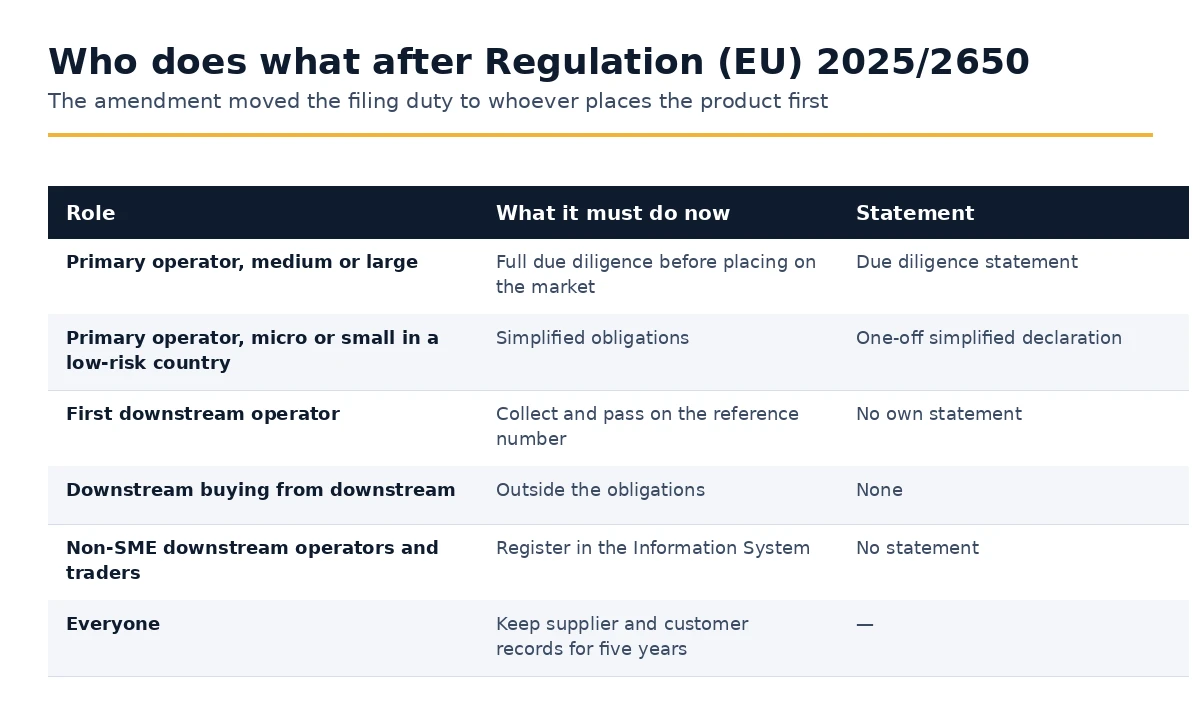
Primary operator, first downstream, further downstream or trader. After the December 2025 amendment this decides whether you file at all.
Medium or large means 30 December 2026; micro or small as of 31 December 2024 means 30 June 2027.
Plot geolocation and legality evidence. If they do not exist yet, the mandate is not the next thing to buy.
Which drives the quote, because a handful of annual statements and thousands of consignments are different services.
After the December 2025 amendment you are a downstream operator. The first downstream operator keeps and passes on a reference number, and anyone buying from a downstream operator is outside the obligations altogether. There is no statement of yours to file and therefore nothing for a representative to file on your behalf. Companies in this position have been quoted for services they do not need, and the amendment is recent enough that the mistake is easy to make in good faith.
The mandate covers the filing, which is the final step. Buying it before the geolocation dataset exists means paying a year of subscription for a service that cannot yet be used. Map first, file second.
Micro and small enterprises have six additional months. Spend them on supplier data and on testing the Information System when it is fully back, and take the mandate closer to the date.
Article 6 lets an operator or trader mandate an authorised representative established in the Union to submit due diligence statements, and it leaves responsibility for compliance with the operator. The dates are 30 December 2026 for medium and large operators and traders and 30 June 2027 for micro and small enterprises, set by Regulation (EU) 2025/2650. Most downstream companies no longer file anything after that amendment, so establish your position before buying. If you are a primary operator or an exporter outside the Union with a December 2026 date and a plot dataset coming together, the mandate is the right purchase; if any of those three is missing, it is not yet.

A natural or legal person established in the Union, mandated in writing under Article 6 to submit due diligence statements on behalf of an operator or trader.
No. The operator or trader remains responsible for the compliance of the relevant products with the regulation.
From 30 December 2026 for medium and large operators and traders, and from 30 June 2027 for micro and small enterprises.
Regulation (EU) 2025/2650, published in the Official Journal on 23 December 2025, which amended Regulation (EU) 2023/1115.
31 December 2020. Products must be deforestation-free by reference to that date, and it has not changed through either postponement.
Cattle, cocoa, coffee, oil palm, rubber, soya and wood, together with the derived products listed in Annex I.
Generally no, after the amendment. The first downstream operator collects and passes on the reference number of the primary operator's statement.
They register in the Information System without submitting their own statements.
A one-off declaration for micro and small primary operators in low-risk countries, replacing continuous due diligence statements.
For full due diligence, yes: coordinates of the plots of land where the commodity was produced. The simplified regime allows postal addresses in defined cases.
Five years, including the identity of suppliers and of the operators or traders you supplied.
No. Collecting plot data, assessing and mitigating risk depend on your supply chain. We file, receive and hold, and we say so before you buy.
The operator is liable. Penalties are set by Member States and include fines proportionate to the environmental damage and the value of the products.
It was reworked after the December 2025 amendment, with access limited during the rebuild. Check its current state before planning a go-live.
No. They were removed from scope by the 2025 amendment.
A draft act in 2026 proposed further changes to the annex, and the Commission's simplification review may bring more. Treat scope as live.
They are unrelated regimes. Physical goods can need both, for different reasons.
On request, because the work depends on filing volume. We quote after an intake call rather than publishing a number that would mislead.
Related: what goes in a statement · dates and commodities
Europe Services, SE in Prague as your Article 6 authorised representative, filing in the Information System with your data and answering the competent authority.
Request this service