
Regulation (EU) 2023/988 · articles 2 and 3 · scope
The General Product Safety Regulation is not another sector rule. It is the net underneath all of them: it applies to consumer products wherever no specific legislation covers the risk, and it applies alongside sector legislation for risks that legislation does not address. That double role is why the scope question is asked so often and answered so badly. This page works through it in the order the regulation itself uses, and names the cases where the answer surprises people.
Consumer productsSecond-handOnline salesSpare partsFree samplesRefurbished
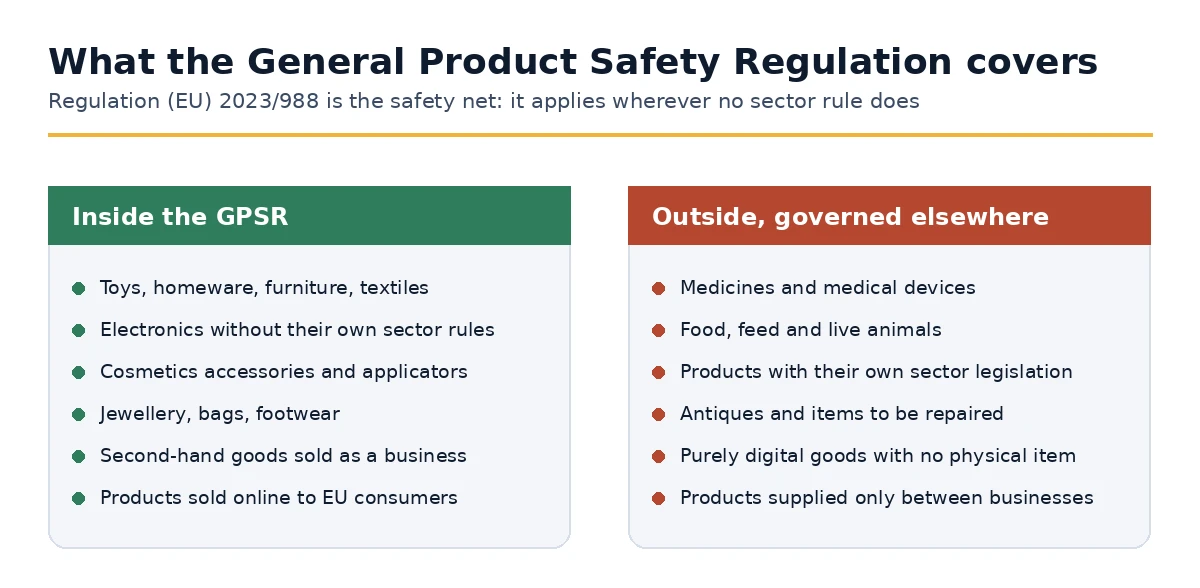
The left column is where most online sellers live. The right column is not a list of exemptions from safety law: those products are regulated more heavily, not less, by rules written for them specifically.
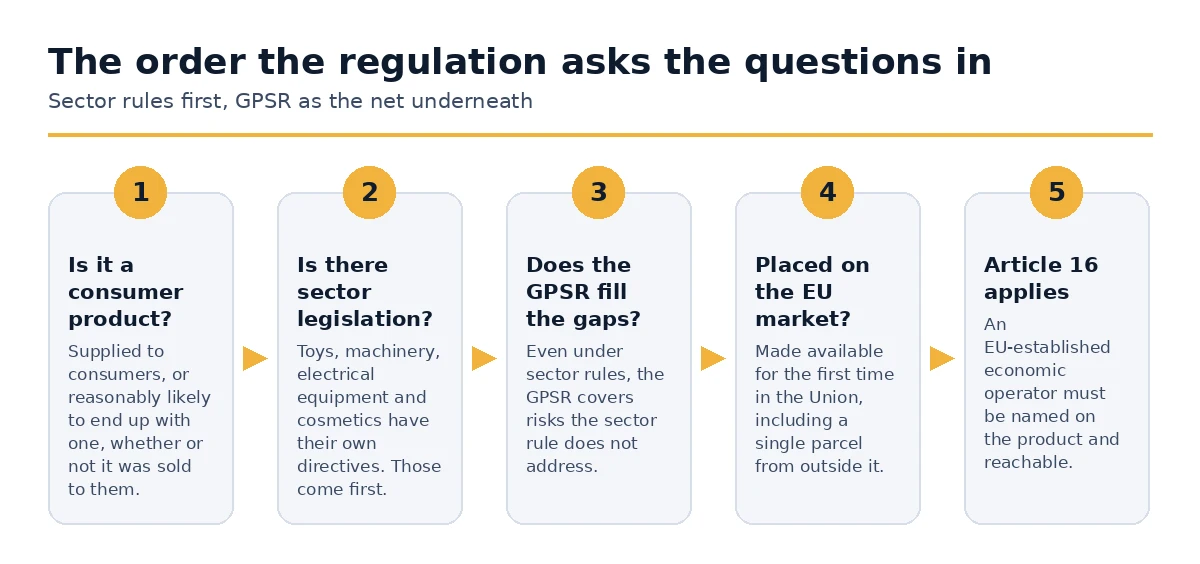
Article 3 defines it as any item intended for consumers or likely, under reasonably foreseeable conditions, to be used by them even if not intended for them. A professional tool sold on a consumer marketplace is caught by the second limb.
Toys, electrical equipment, machinery, cosmetics, personal protective equipment and others have their own directives. Where those apply, they govern the risks they address.
Article 2(1) keeps the GPSR applicable to aspects and risks not covered by the sector rule. A CE-marked toy still falls under the GPSR for anything the Toy Safety Directive does not deal with.
Made available for the first time in the Union, in the course of a commercial activity, whether or not against payment. A single parcel from outside the Union counts.
| Situation | In scope? | Why |
|---|---|---|
| Second-hand goods sold by a business | Yes | Article 2 covers used, repaired and reconditioned products, unless supplied as antiques or as items to be repaired before use, and told so |
| Free samples and promotional gifts | Yes | Making available does not require payment |
| Spare parts sold separately to consumers | Yes | They are consumer products in their own right |
| Purely digital products | No | No physical item is placed on the market; the DSA and consumer law apply instead |
| A physical item bundled with a digital service | Yes | The item is assessed as a product, including the safety of connected features |
| Products sold only to businesses | No | Unless they are reasonably likely to end up with consumers, which is the usual complication |
| Custom and handmade items | Yes | Volume is irrelevant; a single handmade candle sold to a consumer is a consumer product |
| Antiques | No | Explicitly excluded, provided they are supplied as such |
Scope is not the interesting part on its own. This is what follows from it, and it is the same for a candle and for a laptop stand.
Article 16: a manufacturer, importer, authorised representative or fulfilment service provider established in the Union, named on the product or its packaging.
Written, proportionate to the product, kept in the technical documentation. For simple products this is short, but it has to exist.
Held and made available to authorities on request. The representative keeps a copy so a request does not depend on finding a folder.
A batch or serial identifier, and a way to reach affected consumers if something goes wrong. Without the identifier, a recall takes the whole reference.
Platforms do not apply the scope test; they apply a category test, which is broader and blunter. This is why sellers of items arguably outside the regulation still find their listings blocked.
If your item sits in a category the platform has flagged, the responsible person field becomes mandatory whatever the legal position of that specific product.
Arguing that your product is out of scope with a marketplace support agent has never once worked. Filling the field takes minutes; the argument takes weeks.
Etsy sellers of digital downloads have seen the fields appear. The regulation does not cover them, the platform's category logic does.
Filling the marketplace field does not put the details on the product, which is what an inspector opens the box to find.
Scope is not only about the product, it is about the moment. These are the points where sellers assume the duty has not started yet, or has already finished.
| Moment | Are you obliged? | Why |
|---|---|---|
| Stock sitting in an EU warehouse, unsold | Not yet | Making available happens on supply, so there is still time to regularise |
| The first consumer order | Yes | That is the placing on the market of that unit |
| Listing published but nothing sold | Effectively yes | Marketplaces require the fields before the offer goes live |
| Product discontinued last year | Yes, for ten years | Documentation and recall capability survive the end of sales |
| Company ceases trading | Obligations do not transfer by themselves | Authorities pursue the operator named on the product |
When you decide a product is outside the regulation, that decision is itself a compliance artefact. Written down properly it takes ten minutes and settles an inspection; taken in someone's head it is indistinguishable from having ignored the question.
One line. If consumers are foreseeable users even though you sell to businesses, say so and explain why they are not.
Cite the directive or regulation by number. "It is CE marked" is not a citation.
And, explicitly, the ones it does not, because those stay with the GPSR.
With the technical documentation, for the same ten years. A dated decision made before the sale reads very differently from one written after a complaint.


Usually yes, in part. Sector legislation governs the risks it addresses, and the GPSR continues to apply to aspects and risks that legislation does not cover.
Yes, when supplied in the course of a business. Used, repaired and reconditioned products are covered. Antiques and products supplied explicitly as needing repair before use are not.
In scope. Making a product available on the market does not require payment, so promotional items and samples are treated like any other supply.
No physical item, no product safety obligation under this regulation. Marketplaces may still ask for the fields, because their category rules are broader than the law.
Only if consumers are not reasonably likely to end up with the item. Selling the same reference through a consumer channel removes the argument.
Sold separately to consumers, yes: they are consumer products themselves. Fitted into a finished product, the finished product's obligations govern.
No. Food, feed, live plants and animals are excluded and covered by their own legislation, which is stricter rather than lighter.
Excluded from the GPSR and governed by the MDR, IVDR or pharmaceutical legislation. Different authorities and a different kind of representative.
Yes. There is no volume threshold. A single handmade item sold to a consumer in the Union is a consumer product placed on the market.
Yes. That parcel is the first making available in the Union, which is why direct-shipping sellers need an EU-established operator more urgently than anyone.
Substantial modification makes the modifier the manufacturer for the modified aspects. Simple cleaning and testing does not.
Scope decides whether the regulation applies. Article 16 then decides who must be named and reachable inside the Union. A product can be in scope while you have nobody named, which is the situation marketplaces detect.
Yes, proportionate to the product. For a plain textile item it can be a page; the requirement is that it exists and sits in the technical documentation.
Ten years from the moment the product is placed on the market, available to authorities on request.
We give you the analysis and the operator; we are not a testing laboratory and we do not issue CE certificates. Where sector testing is required, that is a laboratory's job.
They write to the operator named on the product. We log the request, answer within the deadline and forward it to you the same working day, with the documentation we hold.
Related: what Article 16 requires · what goes on the label
Europe Services, SE in Prague as your Article 16 responsible person, appointed within 24 hours, with the exact label wording and a certificate anyone can verify.
Appoint a responsible person