
Directive 2009/48/EC · EN 71 · Article 16 GPSR
Toys are the most heavily regulated consumer category in the Union and the one where sellers most often buy the wrong service. A representative cannot give you a CE mark, and a CE mark does not give you someone established in the Union to answer for the product. You need both, they come from different places, and the order matters because the expensive part is testing, not paperwork.
EN 71-1EN 71-2EN 71-3EN 62115Declaration of ConformityAge marking
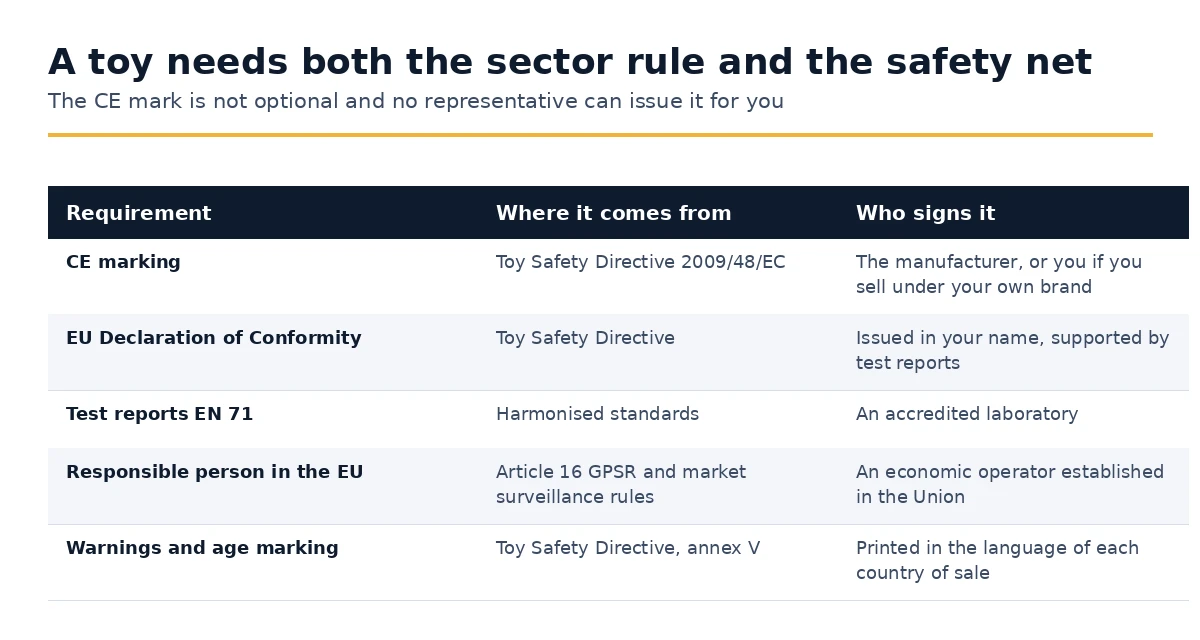
Read the third column carefully. The Declaration of Conformity is issued in the name of whoever places the toy on the market under their brand, which for most online sellers means them, not the Chinese factory that made it.
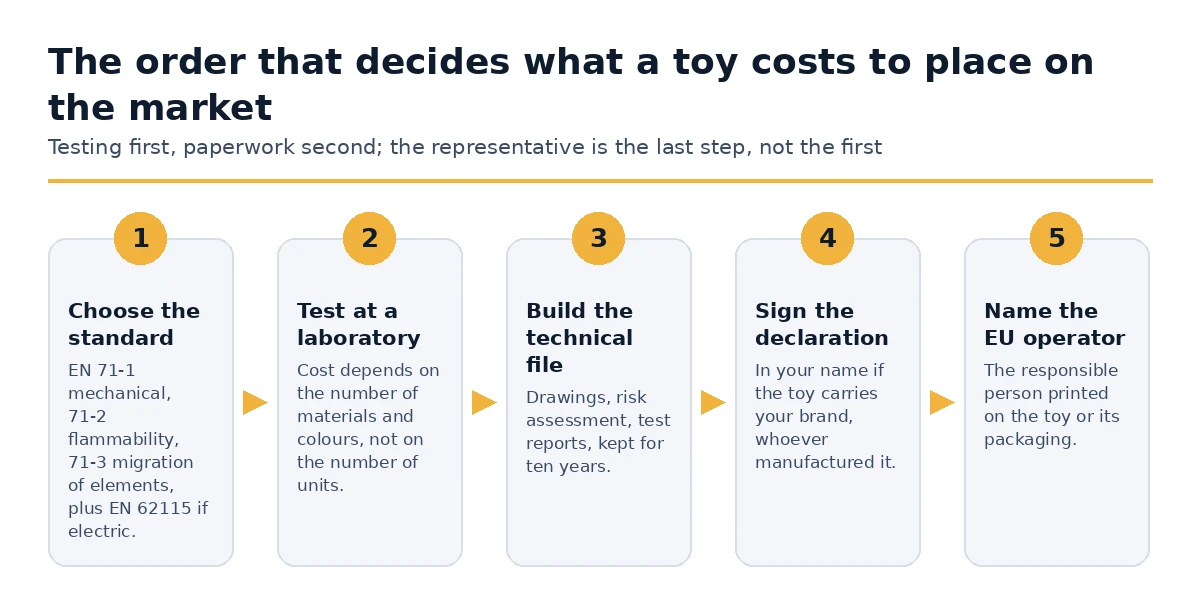
EN 71-1 for mechanical and physical properties, EN 71-2 for flammability, EN 71-3 for migration of certain elements, EN 62115 where the toy is electric. Chemical requirements follow from the directive's annex II.
Cost scales with the number of materials, colours and components, not with the number of units. A toy with six plastic colours costs more to test than one with two, whatever the order size.
Drawings, a risk assessment, the test reports, the description of the production process. Kept for ten years and produced on request.
In your name if the toy carries your brand. Signing it without the test reports behind it is the single most common enforcement failure in this category.
The responsible person printed on the toy or its packaging, reachable by authorities. This is our part, and it is the last step, not the first.
| Element | Requirement | Where it goes |
|---|---|---|
| Not suitable under 36 months | The written warning, with an indication of the hazard | On the toy, the packaging or a leaflet, visible before purchase |
| Age pictogram | Optional in form, but if used must follow the directive | Packaging, next to the written warning |
| Adult supervision warnings | For specific categories: chemical sets, aquatic toys, functional toys | Packaging, in the language of the country of sale |
| Language | Warnings in a language easily understood by consumers | Per market: a German buyer needs German |
| Manufacturer and operator | Names and addresses under the directive and Article 16 GPSR | On the toy where possible, otherwise the packaging |
Sellers assume the CE mark closes the file. It closes the risks the directive addresses. The GPSR remains applicable to everything it does not, and to the market surveillance machinery around it.
Article 2 of the GPSR keeps it applicable to aspects and risks not covered by sector legislation, which is where novel designs and connected features land.
The requirement that someone established in the Union be named and reachable applies regardless of the CE mark.
The procedures for withdrawing a product and informing consumers come from the GPSR framework.
Platforms apply their own category rules and will demand the responsible person fields whatever your CE documentation says.
Stated plainly, because this is the category where clients most often ask us for something we would be wrong to sell them.
Act as the EU-established responsible person, hold your technical documentation, appear on the packaging, and answer authorities and consumers in eight languages.
Issue CE certificates, perform or arrange EN 71 testing, or sign a Declaration of Conformity on your behalf. Those are a laboratory's and a manufacturer's jobs.
Sign a mandate for a toy with no test reports behind it. It would put our name on a product nobody has assessed.
Tell you which standards your item falls under and what to ask the factory for, before you spend money at a laboratory.
Clients ask what "technical documentation" means in practice. It is a folder with six things in it, and it is produced on request rather than filed anywhere.
| Item | Who produces it | Typical form |
|---|---|---|
| Description and drawings | Manufacturer or you | Photos, dimensions, materials by component |
| Risk assessment | You, as the entity placing it on the market | Hazards, users, foreseeable misuse, mitigations |
| Test reports | Accredited laboratory | EN 71-1, 71-2, 71-3, EN 62115 where electric |
| Declaration of Conformity | You, signed | One page naming the toy, the directive and the standards |
| Production controls | Factory | How consistency between units is ensured |
| Labels and warnings | You | Artwork proofs per market language |
Reports age. A certificate from four years ago for a different colourway is not evidence about your unit.
If they name a different brand, they belong to that brand's file, not yours.
Check the accreditation. Reports from unaccredited testing houses are refused during enforcement.
Migration testing is material and colour specific. A new colour is a new test, not a variation of an old one.
If the toy carries your brand, you do, and you need every item above before you can.
Enforcement in this category is more active than in any other consumer sector, and the pattern of findings is consistent across Member States.
| Finding | How it surfaces | Consequence |
|---|---|---|
| Declaration signed without test reports | Authority requests the file | Product withdrawn, declaration treated as false |
| Small parts on a toy marked 3+ | Market surveillance sampling | Recall, entry in the EU Safety Gate |
| Warnings only in English | Inspection at retail or at the border | Consignment held until relabelled |
| No EU operator named | Marketplace field check or customs | Listings blocked, goods refused entry |
| Reports belong to another brand | File request during an investigation | Treated as no documentation at all |
Which standards apply to this design, and does the factory already hold reports for the exact materials and colours you want.
Who will sign the Declaration of Conformity. If it is you, budget for testing now rather than discovering it at customs.
Label artwork approved per market, warnings translated, the EU operator named on the packaging.
The technical file assembled and stored, and the designation signed so the marketplace fields can be filled the same day.


No. CE marking follows from conformity assessment against the Toy Safety Directive, with test reports and a Declaration of Conformity. No representative can issue it and any provider claiming otherwise should be avoided.
Whoever places the toy on the market under their own name or trade mark. For most online sellers importing from Asia, that is the seller, not the factory.
It depends on materials, colours and components rather than order size. Budget per reference, and expect a multi-part quote covering mechanical, flammability and chemical migration.
Only if you receive the test reports and the technical file, and only if the declaration names an entity you can rely on. A CE logo printed on a box proves nothing on its own.
Only where the manufacturer has not applied the harmonised standards in full. Testing to EN 71 at an accredited laboratory is the usual route and does not require one.
An authorised representative under the directive is one of the economic operators that can hold the Article 16 role. In our case Europe Services, SE performs that role by written mandate.
Yes, for risks the directive does not cover and for the economic operator, traceability and recall requirements.
Sold in the course of a business, they are in scope. The safety expectations do not fall away because the item is used.
If they are designed or intended for play by children under 14 they are toys. Items clearly marketed to adult collectors may fall outside the directive but remain under the GPSR.
All of them, into a language easily understood by consumers in each country of sale. Names and addresses are not translated.
Yes. One appointment covers every reference; testing, by contrast, is per product.
The responsible person cooperates with authorities, and the corrective action is coordinated with you. The obligation to fund and execute it stays with the manufacturer.
EN 62115 applies, alongside the Low Voltage and EMC requirements where relevant. Batteries bring their own rules on accessibility of compartments.
Ten years from placing the toy on the market, available on request. We hold a copy so a request does not depend on the factory answering.
We will tell you exactly what to ask for and which standards apply. What we will not do is sign a mandate for a product with no assessment behind it.
Within 24 hours of a completed form, once the documentation exists. That is the quick part; testing is not.
Related: what falls under the GPSR · what goes on the label
Europe Services, SE in Prague as your Article 16 responsible person, appointed within 24 hours once your documentation exists, with a verifiable certificate.
Appoint a responsible person