
REP27 · GPSR · Label requirements
Article 16 · Regulation (EU) 2023/988 · labelling
Marketplace fields are the part sellers see. The label is the part authorities see. Under Article 16 the name and postal address of the responsible person must appear on the product, on its packaging, on the parcel or on an accompanying document — and a compliant Seller Central entry does nothing for a box that is silent. This page is the exact content of that label, language by language, with the mistakes that stop consignments at the border.
ProductPackagingParcelAccompanying documentWarningsBatch
Nothing here is optional, and none of it is satisfied by a marketplace form. Read it as a printing specification rather than as legal text.
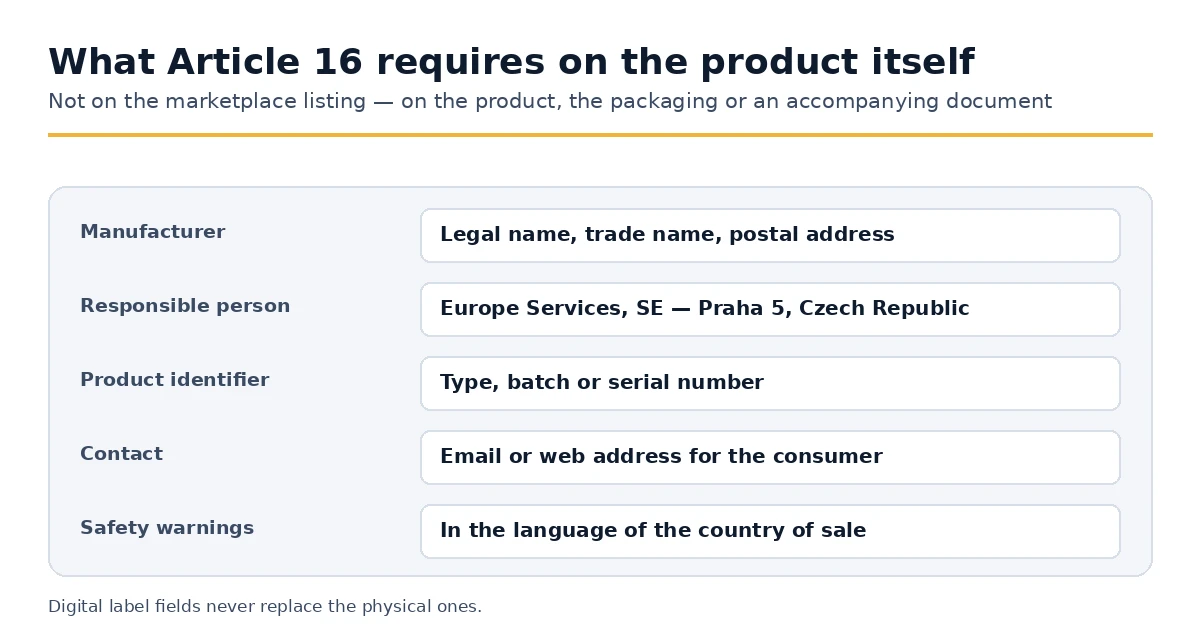
Legal name or registered trade mark, plus a postal address. A brand written on the front of the box is not an identification: authorities are looking for an entity they can write to.
Name and postal address inside a Member State. This is the line our clients print as Europe Services, SE — Na Čečeličce 425/4, 150 00 Praha 5, Czech Republic, once the mandate is signed.
Type, batch or serial number. Without it a recall cannot be limited to the affected run, and the whole reference gets withdrawn instead.
In the language of the country of sale, on the product where the risk arises, not only in a manual that gets thrown away with the box.
The information has to survive normal handling. A peeling sticker, a code printed on a shrink wrap that is removed at home, or a page on your website will not do.
Market surveillance rarely disputes the safety of the item itself. It stops consignments over identification, which is cheaper to fix and more often wrong.
The same designation that clears GPSR Amazon listing suppression is the one printed on your packaging: one mandate, two places it has to appear.
The wording to set in your artwork, with the accented Czech characters that most print files break, plus an ASCII fallback that stays legal.
A signed mandate and a certificate with a verification code, so a customs officer or a marketplace can confirm that the name on your box really did accept the role.
Standard safety wording in the languages of the markets you sell into, so the same artwork can serve several countries.
Requests reaching that printed address are logged and forwarded to you the same working day, in eight languages.
Article 16 gives an order of preference rather than a single option, and the order matters when packaging is already printed.
The safest place. Moulded, engraved or printed details survive the box being thrown away, which is what an inspector encounters months after sale.
Acceptable and normal for small items. The details must be on the packaging the consumer receives, not on the outer carton the retailer opens.
Workable for direct-to-consumer sales, but a shipping label that gets binned makes a later inspection harder for you, not for them.
The rescue option for stock already printed: a durable insert placed in the box before the product is made available.
| Mistake | What happens | The fix |
|---|---|---|
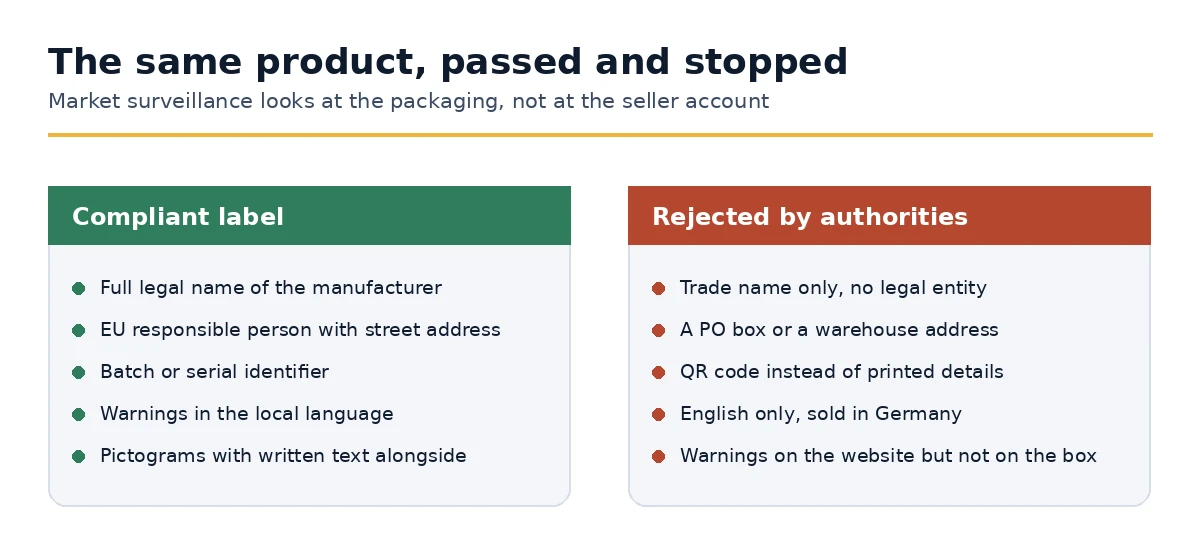
| Trade name only, no legal entity | Treated as unidentified manufacturer | Add the registered company name |
| Responsible person shown as an email | Missing postal address | Print the full street address in a Member State |
| Details only in the online listing | Non-compliant product, compliant listing | Add an insert or a durable label |
| English warnings in a non-English market | Warnings deemed not understood | Translate per market of sale |
| No batch or serial number | Recall cannot be limited | Add a batch code, even a simple date lot |
| UK address after Brexit | Third-country address, refused | Name an EU-established responsible person |
Five of the six are printing decisions rather than legal ones, which is why they are usually cheap to fix and expensive to ignore. The sixth is the reason British sellers form the largest group among the enquiries we receive.


No. A digital medium may add to the label, never replace it. The name and postal address have to be readable without a phone, on the product, the packaging, the parcel or an accompanying document.
Those easily understood by consumers in the Member State where the product is made available. In practice, selling the same item into Germany, France and Poland means three versions of the warning text.
No. A postal address inside the Union is required. Email and web forms are useful additions and satisfy nothing on their own.
Often not. Article 16 accepts an accompanying document, so a durable insert or an additional label applied before the goods are made available can bring existing stock into line.
No. The responsible person must be established in the Union, and since Brexit a UK address is a third-country address here. British sellers are the group most frequently stopped for exactly this.
The duty follows whoever places the product on the EU market. If that is you, apply a compliant label or insert yourself before making the product available; you cannot pass the problem back up the chain.
The regulation does not set one. It requires the information to be visible and legible, and details that need magnification have been treated as absent. Print for someone holding the box.
The identification details are names and addresses, so they are not translated. Warnings and safety instructions are, in the language of each market where the product is made available.
On the packaging the consumer receives. An outer carton opened by the retailer does not reach the person the rule protects.
If you place them on the EU market under your own name or trade mark, you take on the manufacturer's obligations, including the identification on the label.
They can, when the importer is established in the Union and accepts the Article 16 tasks in writing. Many sellers have no EU importer at all, which is exactly why they appoint one of these instead.
Ten years from placing the product on the market, available to authorities on request. We hold a copy so a request does not depend on somebody finding a folder.
If they are consumer products in their own right, yes. Sold as part of a finished product, the identification of the finished product governs.
Related: what Amazon checks and what the law checks · the same problem on Etsy
A signed Article 16 designation within 24 hours, with the exact label wording and a certificate anyone can verify.
Appoint a responsible person