Regulation (EU) 2019/1020 · article 4 · since 16 July 2021
This is the shortest and least known rule in European product law. Article 4 of the market surveillance regulation says that a product covered by the legislation in its annex may be placed on the Union market only if an economic operator established in the Union is responsible for it. Not the seller, not the marketplace, not the courier: a named entity with an address inside the Union, whose details are printed on the product and who holds the file when an authority asks. This page sets out who can be that entity, what it actually does, and where Article 4 stops and Article 16 GPSR begins.
Article 4(1)Article 4(2)Article 4(3)Article 4(4)Article 4(5)
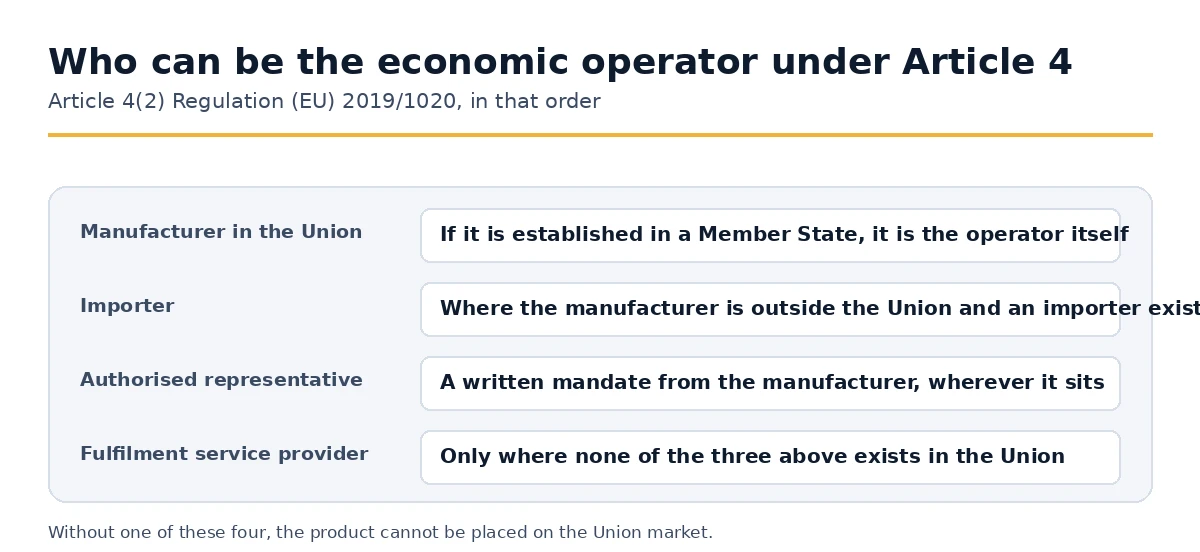
The order in Article 4(2) is not a preference list you can rearrange. If a manufacturer, importer or authorised representative established in the Union exists, that entity is the operator. The fulfilment service provider comes last, and only where none of the others is present, which is why so many logistics companies now refuse the role in their terms.
Article 4(5) lists the legislation concerned. If your product falls under one of these, the rule applies to it.
| Legislation | Products |
|---|---|
| Directive 2014/30/EU | Electromagnetic compatibility |
| Directive 2014/35/EU | Low voltage electrical equipment |
| Directive 2014/53/EU | Radio equipment |
| Directive 2009/48/EC | Toys |
| Directive 2006/42/EC | Machinery |
| Regulation (EU) 2016/425 | Personal protective equipment |
| Regulation (EU) 2016/426 | Appliances burning gaseous fuels |
| Directive 2014/34/EU | Equipment for explosive atmospheres |
| Directive 2014/68/EU | Pressure equipment |
| Directive 2011/65/EU | Restriction of hazardous substances |
| Directive 2009/125/EC | Ecodesign |
| Regulation (EU) 305/2011 | Construction products |
| Directive 2013/53/EU | Recreational craft |
| Regulation (EU) 2019/1009 | Fertilising products |
| And others | Pyrotechnics, lifts, cableways, measuring instruments, simple pressure vessels |
A connected consumer device typically falls under EMC and, if it has a radio, under the radio equipment directive as well. One economic operator covers all the applicable legislation for that product; you do not need one per directive.
Article 4(4) asks for name, registered trade name or trade mark, and contact details including the postal address. On the product itself where the surface allows.
Where the product is too small or the surface unsuitable, the packaging carries it.
For goods shipped directly to consumers, the parcel is an accepted place.
An insert, the manual or the delivery note. This is the route most small manufacturers use.
Not a legal requirement of Article 4 itself, but Amazon, eBay, Etsy and TikTok Shop ask for the same data and hide listings without it.
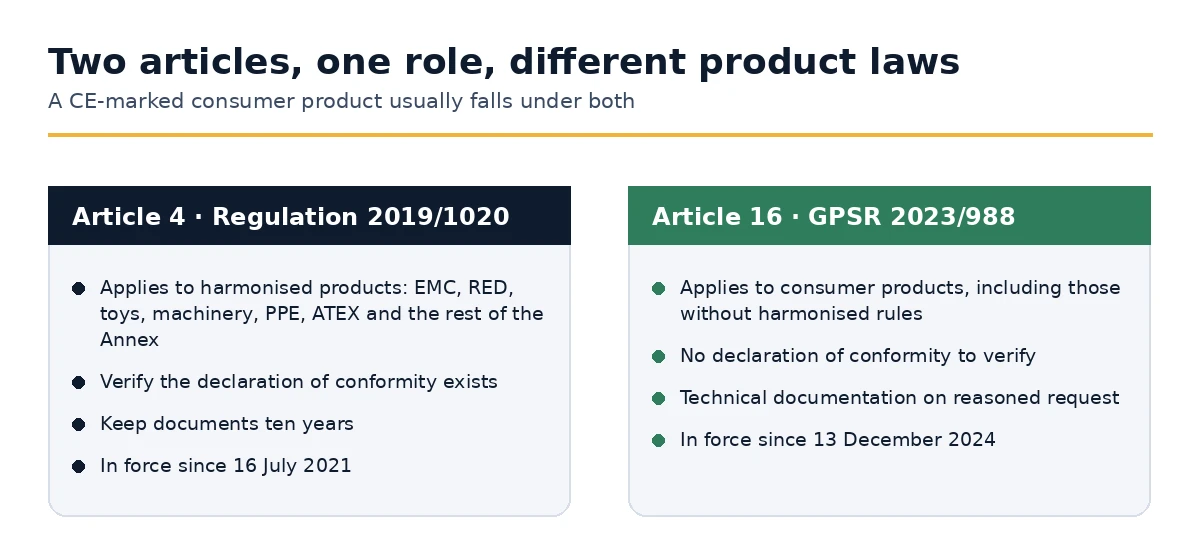
They are the same role written twice, for two different bodies of product law. Article 4 covers harmonised products, the ones with a CE mark and a declaration of conformity. Article 16 GPSR covers consumer products generally, including those with no harmonised rules at all: furniture, textiles, decorative items.
Testing, measurements and the conformity assessment procedure stay with the manufacturer, or with a notified body where the legislation requires one.
The EU declaration of conformity is a statement by the manufacturer, signed in the manufacturer's name. Nobody else can sign it.
Design calculations, test results, risk assessment and the list of applied harmonised standards are the manufacturer's work.
The mark is affixed by the manufacturer, or by the authorised representative on the manufacturer's instructions, on the basis of a completed assessment.
Liability for the product stays where the law puts it. The operator makes the product reachable, not somebody else's problem.
Where an importer exists in the Union, that importer already carries its own obligations under the applicable legislation.
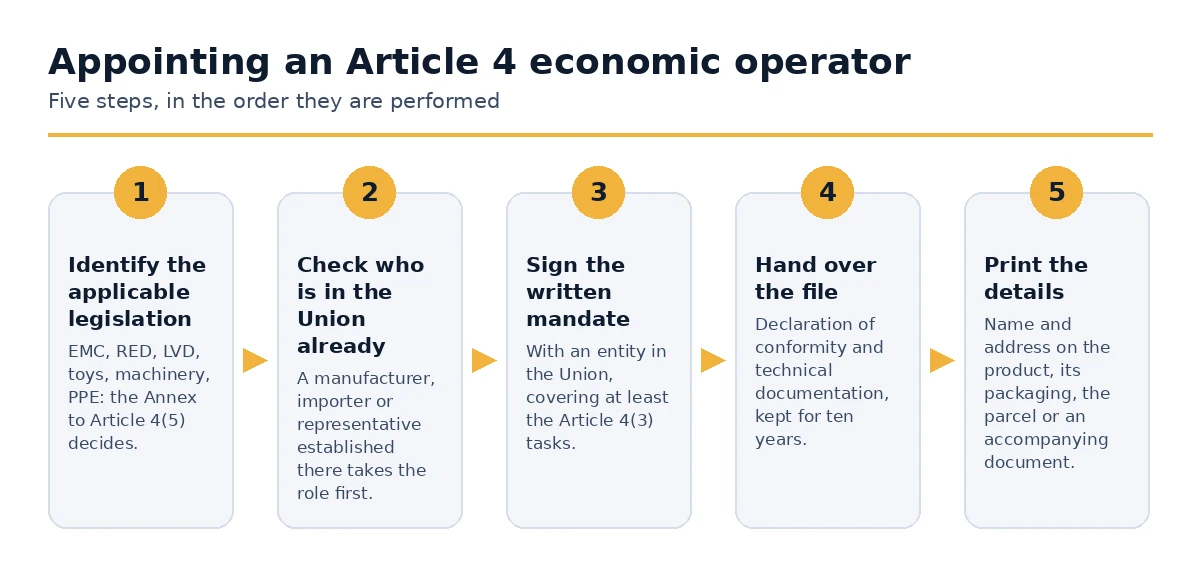
The step that takes longest is the fourth, and it is worth being blunt about it: without a declaration of conformity and a technical file, there is nothing to hold, and no economic operator can accept the mandate. That is not a commercial condition, it is what Article 4(3)(a) requires the operator to verify.
| Situation | Economic operator needed? |
|---|---|
| Manufacturer outside the Union selling direct to EU consumers | Yes, and this is the common case |
| Manufacturer outside the Union selling through an EU importer | No: the importer is the operator |
| Manufacturer outside the Union selling on Amazon FBA | Usually yes: fulfilment providers rarely accept the role |
| Swiss or UK manufacturer shipping to EU customers | Yes: neither is in the Union |
| Manufacturer with a real subsidiary in a Member State | No: the subsidiary is the operator |
| Product with no CE marking and no harmonised legislation | Article 4 does not apply, but GPSR Article 16 usually does |
The third row is where most enquiries come from. Fulfilment service providers appear last in Article 4(2), and their terms almost always exclude the role, which leaves the manufacturer to appoint an authorised representative.
Signed by Europe Services, SE, Na Čečeličce 425/4, Praha 5, IČO 03571785, covering the tasks in Article 4(3) and, where you also need it, Article 16 GPSR.
Your declaration of conformity and technical documentation held for ten years, at the disposal of market surveillance.
The exact text to print on the product, packaging, parcel or insert, in an ASCII version for systems that mishandle accents.
Reasoned requests logged the day they arrive, answered procedurally in the language they came in, forwarded to you the same working day.
With a code anyone can check on a public page, without contacting us.
Conformity assessment, testing, CE marking, drafting your declaration or your technical file. Those belong to you and to laboratories, and we say so before you buy.
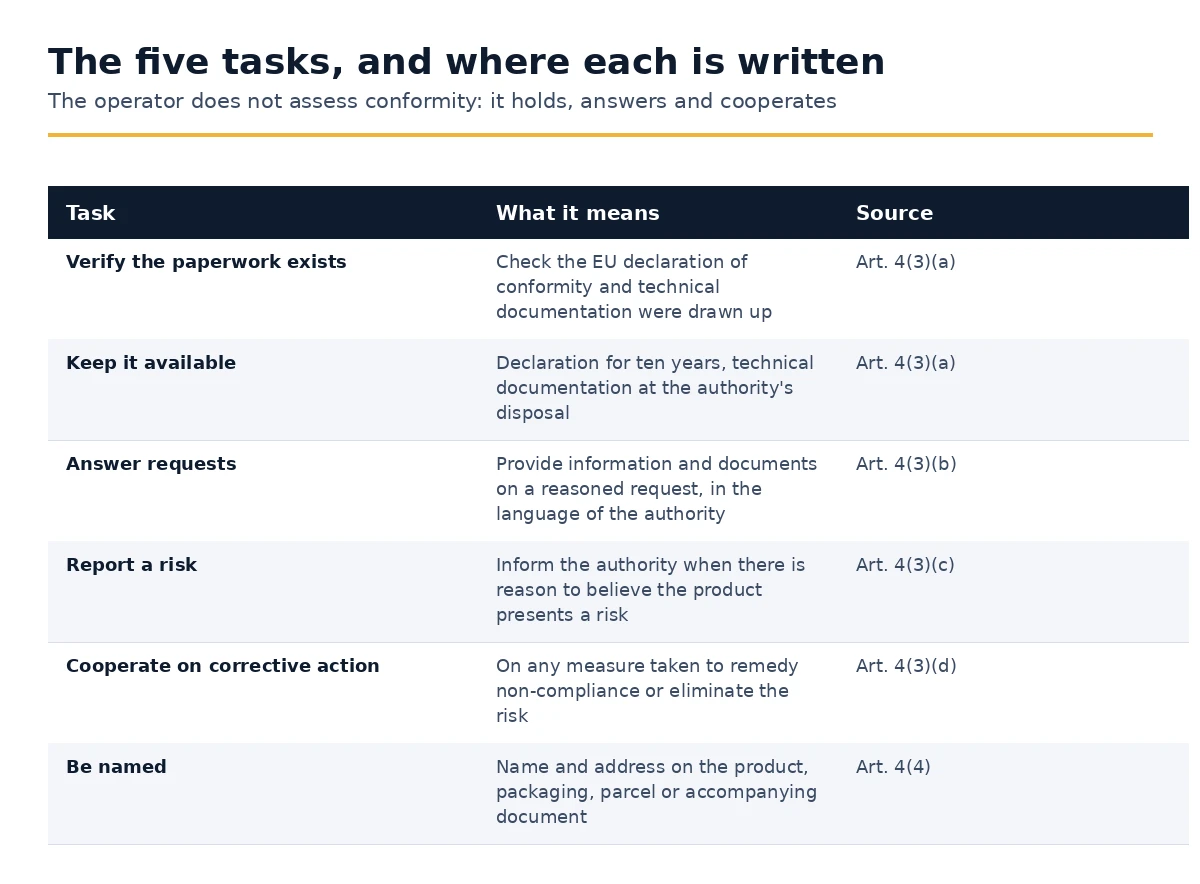
A product covered by the legislation in Article 4(5) can be placed on the Union market only if an economic operator established in the Union is responsible for it. That entity verifies the declaration of conformity and technical documentation exist, keeps them for ten years, answers reasoned requests, informs authorities of a risk, cooperates on corrective action, and appears by name and address on the product or its packaging. It does not test, does not assess and does not sign the declaration. If you make CE-marked products outside the Union and sell them direct, you need one, and the same mandate can cover Article 16 GPSR at the same time.
Market surveillance under this regulation is not theoretical. Authorities in the Member States run coordinated sweeps, buy products online and check exactly this, in a predictable order.
| Stage | What is checked | What a compliant file looks like |
|---|---|---|
| Visual | Is a name and address of an operator in the Union present? | Printed on the product, packaging, parcel or insert |
| Existence | Does that entity exist and is it established in the Union? | A registered company with a verifiable number |
| Reachability | Does it answer a reasoned request? | A reply within the deadline, in the language of the request |
| Documents | Declaration of conformity and technical documentation | Produced without a delay of weeks |
| Substance | Do the documents match the product on the shelf? | Model numbers, standards and dates that correspond |
The first three stages are where products fail, and none of them is about safety. A perfectly safe product with no reachable operator is stopped exactly like a dangerous one, which is the part manufacturers find hardest to accept.
Asks for the EU responsible person in the compliance section of Seller Central and hides listings without it. The same fields serve Article 4 and Article 16.
Requires the details on the listing page for EU sites, with product safety fields that must be filled per item.
Blocks EU visibility for physical goods until a responsible person is entered.
Collects the data at onboarding and suspends items that lack it.
No gatekeeper, but the same rule applies, and here the first sign of a problem is a letter rather than a hidden listing.
Legal name, postal address, email. Exactly the data on the certificate we issue.
A group subsidiary that genuinely imports, or an importer of record, is the operator already. Buying a mandate on top of that is paying twice.
If not, that comes first. No operator can verify a document that has not been drawn up.
If yes, you want Article 16 GPSR in the same mandate rather than a second contract later.
Article 4 is not enforced only in shops and warehouses. Chapter VII of the same regulation puts customs authorities in the chain, and that is what turns a paperwork rule into a stopped container.
| Provision | What it allows | Practical effect |
|---|---|---|
| Article 25 | Controls on products entering the Union market | Customs check before release for free circulation |
| Article 26 | Suspension of release | Goods held where the operator details are missing or the documents are not produced |
| Article 27 | Release where compliance is shown | The suspension ends once the file arrives |
| Article 28 | Refusal of release | Consignment refused; the product does not enter |
The order of events matters commercially. A suspension is not a fine: it is stock sitting at a port accruing storage while somebody in another time zone looks for a declaration of conformity. Manufacturers who have been through it once never argue about the mandate again.
Placing on the market is the first making available of a product on the Union market. Each individual product is placed on the market when it is first supplied for distribution, consumption or use.
A product offered online to customers in the Union is treated as placed on the market. Article 6 of the regulation says so expressly, which closes the argument that a shipment from abroad is somehow outside.
Compliance is assessed per product placed, which is why a change of design or supplier restarts the question rather than inheriting the old answer.
Goods held in a warehouse without being offered are not yet placed on the market, though fulfilment providers are drawn in by Article 4(2) precisely because that line is thin.
Products substantially modified become new products for this purpose, and the modifier takes the manufacturer's obligations.
Supplied in the course of a commercial activity, they are made available, whether or not money changes hands.
Both can be the economic operator, but they are not the same thing and the difference decides who carries what.
| Point | Importer | Authorised representative |
|---|---|---|
| Relationship | Buys and resells the product in its own name | Acts under a written mandate, does not own the goods |
| Own obligations | Full importer duties under the applicable directive | Only the tasks in the mandate, at least those in Article 4(3) |
| Name on the product | Yes, as importer, under the applicable legislation | Yes, as the Article 4 operator |
| Checks conformity | Must verify the assessment procedure was carried out | Verifies the documents were drawn up |
| Commercial risk | Owns the stock | None: it is a service |
| Typical case | A European distributor buying containers | A manufacturer selling direct to consumers |
If a European distributor already imports your goods, you have an operator and do not need this service for those units. What catches manufacturers out is a mixed model: distributor for the retail channel, direct shipping for the webshop. The direct units still need an operator, because the distributor never touched them.
| Product | Applicable legislation | Operator needed if outside the Union |
|---|---|---|
| Bluetooth speaker | EMC, radio equipment, RoHS, ecodesign where relevant | Yes |
| Wooden toy for children | Toy safety directive, plus GPSR for the rest | Yes |
| Safety gloves | Regulation (EU) 2016/425 on personal protective equipment | Yes |
| Cotton t-shirt | None harmonised: no CE marking | Article 4 no, GPSR Article 16 yes |
The regulation requires Member States to lay down effective, proportionate and dissuasive penalties. Amounts differ by country and are set in national law.
Authorities order the non-compliance to be brought to an end: correct the labelling, provide the documents, appoint an operator.
Prohibition or restriction of making available, withdrawal from the market, recall from end users where the risk requires it.
Information on dangerous products and measures taken is shared through the Union rapid alert system, which is public.
A hidden marketplace listing, a suspended consignment or a recall costs more than any of the above, and arrives faster.
| Item | Who does it | Where it ends up |
|---|---|---|
| Identify the applicable legislation | Manufacturer | The technical file |
| Apply the harmonised standards | Manufacturer, with a laboratory where chosen | Test and calculation results |
| Carry out the conformity assessment | Manufacturer, or notified body where required | The procedure record |
| Draw up the technical documentation | Manufacturer | Held ten years |
| Sign the EU declaration of conformity | Manufacturer only | Accompanies the product where required |
| Affix the CE marking | Manufacturer | On the product |
| Appoint the economic operator | You, by written mandate | Name and address on the product |
| Keep the file reachable | The operator | Produced on reasoned request |
Seven of the eight rows are the manufacturer's. That proportion is the honest summary of this service: we hold the last two lines, and the value is that they are the ones an authority reaches first.
Regulation (EU) 2023/1230 replaces the machinery directive from 20 January 2027, with its own authorised representative rules.
Regulation (EU) 2024/2847 adds security requirements for products with digital elements, with reporting from 11 September 2026 and full application from 11 December 2027.
The GPSR has applied since 13 December 2024 and reaches consumer products that no harmonised legislation covers.
Regulation (EU) 2024/1781 introduces the digital product passport progressively, per product group.
Article 4 itself. It has applied since 16 July 2021 and the obligation is stable while everything around it moves.
One entity in the Union, holding the file and answering, is the constant across all of them. The mandate can be extended as new regimes arrive rather than renegotiated.

It requires that a product covered by the legislation listed in Article 4(5) may be placed on the Union market only if an economic operator established in the Union is responsible for it.
16 July 2021, when the market surveillance regulation became applicable.
A manufacturer established in the Union, an importer, an authorised representative with a written mandate, or a fulfilment service provider where none of the others exists.
Verifies the declaration of conformity and technical documentation were drawn up, keeps them available for ten years, answers reasoned requests, informs authorities of a risk and cooperates on corrective action.
No. Testing and conformity assessment stay with the manufacturer, or with a notified body where required.
No. The declaration is a statement of the manufacturer and only the manufacturer signs it.
Those falling under the legislation in Article 4(5): EMC, low voltage, radio equipment, toys, machinery, PPE, gas appliances, ATEX, pressure equipment, RoHS, ecodesign, construction products and others.
On the product, or on its packaging, the parcel or an accompanying document: name, registered trade name or trade mark, and contact details including a postal address.
It is the same role in a different law. Article 4 covers harmonised products; Article 16 GPSR covers consumer products generally. One mandate can cover both.
Rarely. They appear last in Article 4(2) and their terms usually exclude it, which is why manufacturers appoint an authorised representative instead.
No. Where an importer established in the Union exists, that importer is the economic operator.
Yes. Switzerland is not in the Union, so a Swiss manufacturer selling direct to EU customers needs an economic operator established in a Member State.
No. One economic operator covers the applicable legislation for the products in the mandate.
The product may not be placed on the Union market. Market surveillance can order withdrawal, and marketplaces hide listings that lack the details.
Ten years from placing the product on the market, or as the applicable legislation specifies.
No. We can send the blank template and the list of what belongs in it, but the declaration is signed by the manufacturer on the basis of its own assessment.
Within 24 working hours of a completed form, once the declaration of conformity and technical documentation are available.
No, that is a separate designation under a different regulation, but we issue both with one renewal date.
Related: Article 16 GPSR responsible person · which products fall under the GPSR
Europe Services, SE in Prague as your economic operator under Article 4 and, where you need it, your responsible person under Article 16 GPSR.
Request this service