
REP27 · Marketplaces · Etsy
Etsy · Article 16 GPSR · Article 27 GDPR
Etsy collects a responsible person for product safety and blocks EU listings without one. It does not ask about the personal data of your European buyers, and that obligation is separate, older and carries larger consequences. Shops that solved the Etsy prompt often believe they are done. This page covers both roles, who is genuinely caught, and the handmade cases where the answer is not what sellers expect.
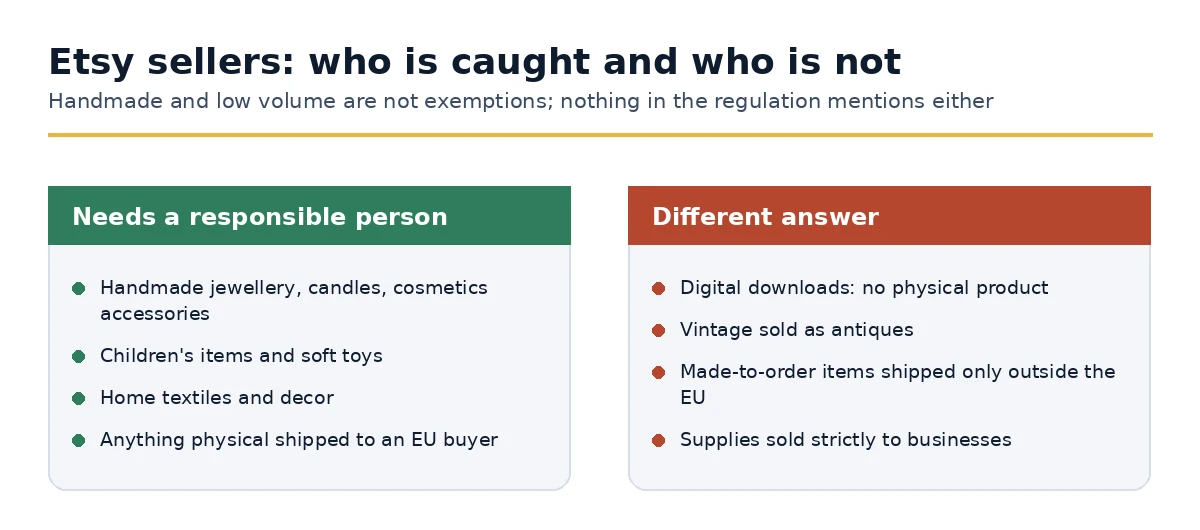
HandmadeDigital downloadsVintageMade to orderArticle 16Article 27
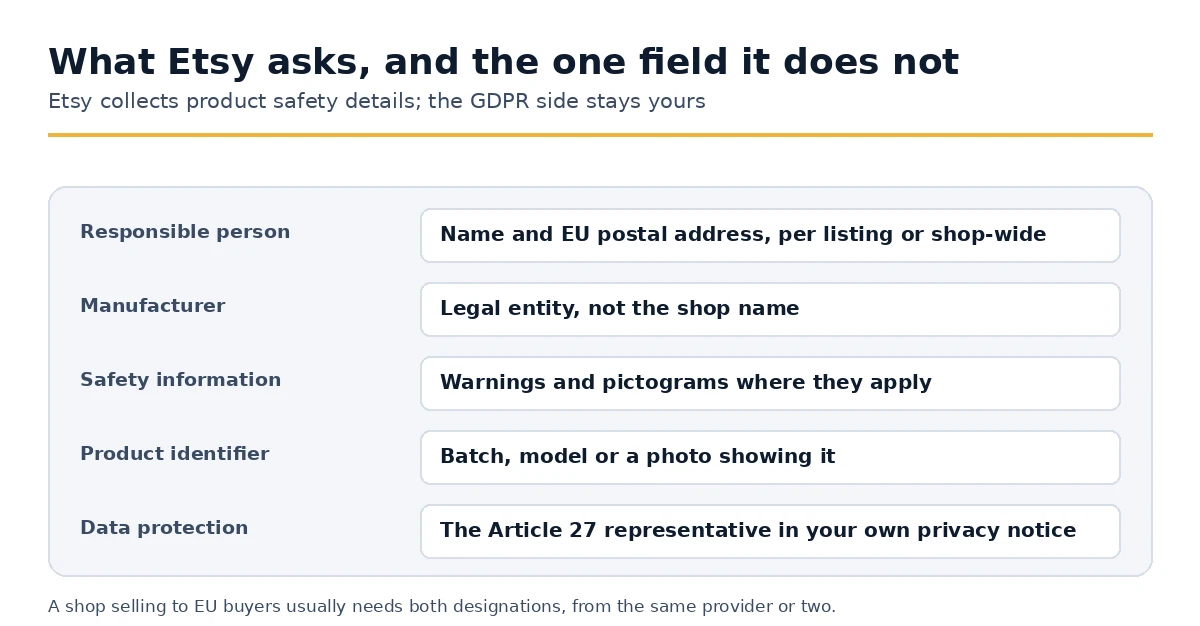
The last line is the one nobody prompts you about. If you email buyers, run your own newsletter, or ship from your own systems, the personal data side is yours to handle.
| Point | Responsible person | EU representative |
|---|---|---|
| Source | Article 16 GPSR | Article 27 GDPR |
| Covers | The safety of the item | The personal data of your buyers |
| Where it appears | Etsy fields and the product label | Your shop policies and privacy notice |
| Who enforces | Etsy, then market surveillance | Supervisory authorities |
| If missing | Listings hidden from EU buyers | Fines up to €10 million or 2% of turnover |
| Price with us | From €290 | From €290, €890 for both |
Candles fall under the GPSR with specific warning expectations; cosmetics themselves have their own regime and a different responsible person.
The Toy Safety Directive applies on top, with CE marking and EN 71 testing. A designation does not replace it.
No physical product, so the GPSR does not apply, but Etsy's category logic may still show the fields. Filling them is faster than arguing.
Genuine antiques supplied as such sit outside. Ordinary second-hand items sold as a business do not.
Custom work is a consumer product like any other. The identification requirement does not depend on the item being stocked.
Copy-and-paste strings for Etsy's responsible person fields, with an ASCII fallback for tools that break on accented characters.
What to print on the swing tag or insert, because Etsy fields do not travel with the parcel.
Article 13(1)(a) wording for your shop policies and any newsletter you run outside Etsy.
Each with its own verification code, so a buyer or an authority can check them independently.
| Shop | Responsible person | Article 27 |
|---|---|---|
| US shop shipping jewellery to the EU | Yes | Yes, if any buyer data is handled outside Etsy |
| UK shop, candles and home fragrance | Yes, UK address refused | Yes, same reason |
| Shop selling digital planners only | No physical product | Yes, if you run a mailing list |
| EU-based shop selling within the EU | Can name itself | Not required, already established |
| Canadian shop, made-to-order clothing | Yes | Yes |
| Vintage seller, genuine antiques only | Outside | Yes, if you process buyer data yourself |
Proportionate to the item. For a plain ceramic mug this is a page; for a child's toy it is not.
For blanks, dyes, waxes and findings. Ask before you buy, not after a complaint.
Even a simple date code. Without it a recall takes your whole listing rather than one run.
What you actually printed, per market language, kept for the ten years the regulation requires.
With the Article 27 representative named, if you handle buyer data outside the platform.
The two obligations fail in completely different ways, and the difference explains why so many shops fix one and never hear about the other.
| Failure | How you find out | How fast it hurts |
|---|---|---|
| No responsible person | Listings hidden from EU buyers | Immediately, and visibly |
| Details missing from the parcel | An inspection or a customer complaint | Weeks or months later |
| No Article 27 representative | A data subject request, or a complaint | Only when something goes wrong, and then heavily |
| No privacy notice paragraph | Checked during any complaint | Treated as evidence the designation was cosmetic |
| No risk assessment | Requested with the technical file | Impossible to produce retroactively without it showing |
A shop with a hundred sales a month is unlikely to attract a supervisory authority on its own. What it does attract is a single annoyed buyer who cannot find who to contact, and that is exactly the route Article 27 exists to close.
The largest group of shops we appoint. Both roles usually apply, and the Etsy field is what makes it urgent.
A UK address is refused in the responsible person field. It is not a bug and it will not be reversed.
Same analysis as the United States: no establishment in the Union, so both obligations follow from the sales.
You can name your own business as the responsible person, and Article 27 does not apply at all.
Neither applies. The obligations follow the market you supply, not where you live.
Selling privately rather than as a business falls outside. Regular sales at volume do not, whatever the platform calls the account.
Four things done at the start save the block that arrives later. None of them takes more than an afternoon.
Physical, digital, or made to order. That single answer decides whether the product side applies at all.
Waxes, dyes, findings, blanks. Getting them before the first order is easy; getting them after a complaint is not.
A page for simple items. It is the document that shows the decision was made deliberately.
The field appears when Etsy decides, not when you are ready. A designation in place makes it a two-minute task.
Etsy will tell you about the product side, because a blocked listing is visible and immediate. Nobody will tell you about the data side, because nothing blocks and no field turns red. Both obligations are real, both cost €290 a year on their own and €890 together, and both are signed within 24 hours of a form that takes ten minutes.
Handmade is not an exemption. Small is not an exemption. Selling from outside the Union to buyers inside it is exactly the situation both regulations were written for, and a one-person shop is treated the same way as a company with a warehouse.


No. Etsy collects the details and hides listings that lack them. It is a marketplace, not an economic operator for your products.
No. The regulation has no volume threshold and does not mention handmade. One item sold to an EU consumer is enough.
The GPSR covers physical products, so legally no. Etsy's category rules may still request the fields.
Genuine antiques supplied as antiques are outside. Ordinary used goods sold as a business are inside.
If Etsy handles all the buyer data and you never process it outside the platform, the case is weaker. If you run a newsletter, ship yourself or export customer lists, it applies.
If you are established in the Union, you may not need a representative at all. The role exists for sellers outside it.
Not since Brexit. Etsy's country field accepts Member States only, which is why British sellers are the largest group affected.
The Toy Safety Directive applies on top of the GPSR: CE marking, EN 71 testing and a declaration in your name.
No. One appointment covers the whole shop and every European Etsy site.
Your listings stop being visible to EU buyers. Reinstatement is quick once valid details are saved; the lost ranking is not restored.
Yes. Article 16 requires the details on the product, packaging or an accompanying document. Etsy fields are not the product.
A proportionate risk assessment and supplier statements, for ten years. For simple handmade items this is short but must exist.
We supply standard wording per market language. Product-specific testing, where required, is a laboratory's job.
Signed within 24 hours of a completed form, with the field values ready to paste into Etsy.
€290 a year for one role, €890 for the plan covering both the responsible person and the Article 27 representative.
No. One designation covers every European marketplace; only the language of the warnings changes per market.
Related: the GPSR side in detail · the same problem on eBay
The Article 16 responsible person and the Article 27 representative, signed within 24 hours, with the Etsy field values and the label wording included.
See the plans