
REP27 · Article 27 · Ireland
Article 27(3) GDPR · place of designation
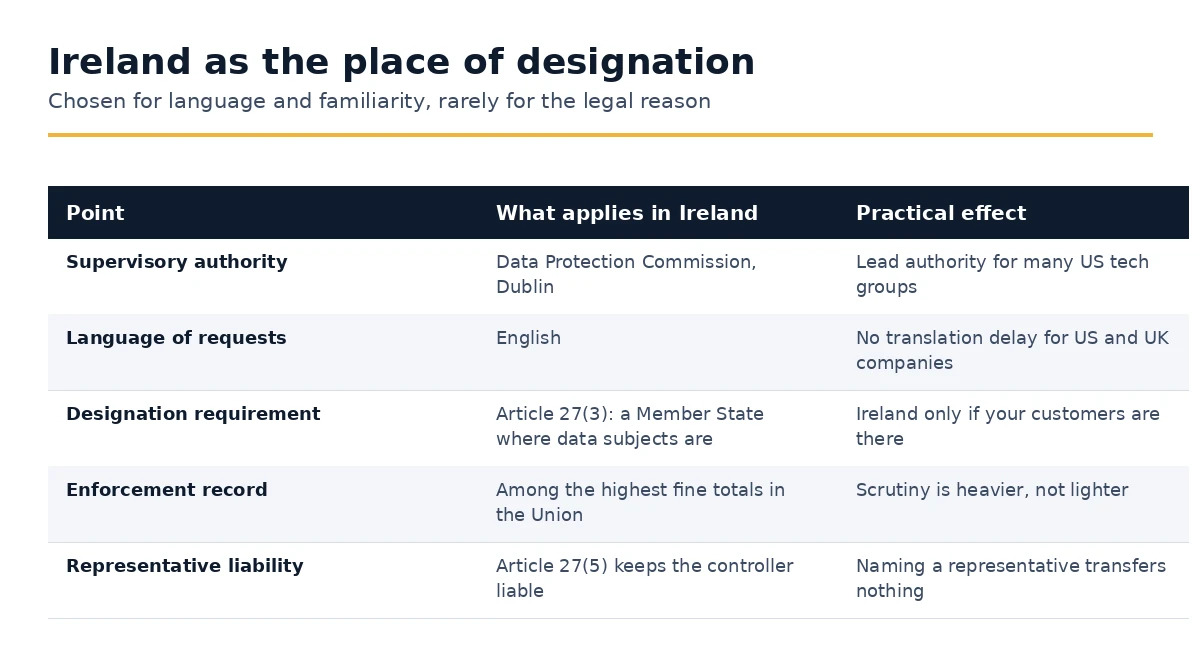
A GDPR representative in Ireland — an EU representative Ireland designation, in the phrasing people search for — is the most requested country for an Article 27 designation among American and British companies, and the reason given is almost always the same: English, familiar, where the big platforms are. Article 27(3) asks a different question. It ties the place of designation to where your data subjects are, not to where you feel comfortable. Sometimes those coincide. Often they do not, and the choice quietly raises your exposure instead of lowering it.
Data Protection CommissionEnglish-language requestsArticle 27(3)Article 27(5)One desk, 27 states
One sentence decides it: the representative shall be established in one of the Member States where the data subjects are, whose personal data are processed in relation to the offering of goods or services to them, or whose behaviour is monitored.
If your EU revenue is German and Dutch, an Irish designation sits outside the group of countries the article points to. It is not automatically void, but it is harder to defend.
The article fixes where the representative is established. It never asks for one per country: a single valid designation is effective across the Union.
The one-stop shop belongs to controllers established in the Union. Designating in Dublin does not buy you the Data Protection Commission as a single interlocutor.
Article 27(5) is explicit: proceedings can still be brought against the controller or processor directly.
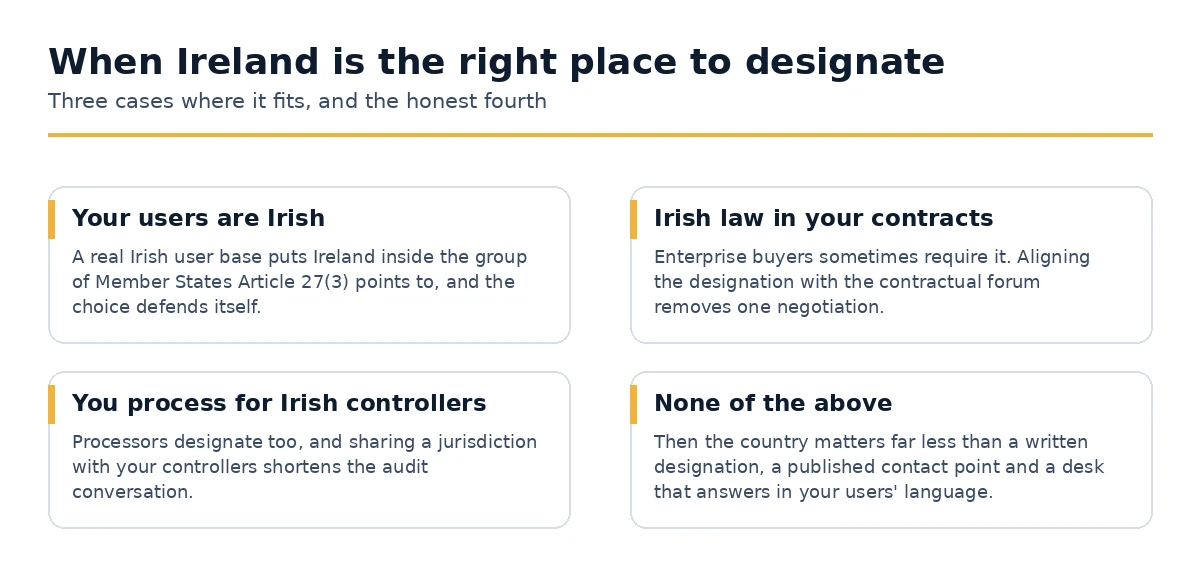
Searches for a GDPR representative Ireland almost always come from one of three situations, and only these three make the country itself part of the answer.
A real Irish user base makes Ireland one of the Member States Article 27(3) points to, and the choice becomes straightforward.
Enterprise buyers sometimes require it. Aligning the designation with the contractual forum removes a negotiation step.
Processors need a representative too, and being reachable in the same jurisdiction as your controllers shortens the audit conversation.
Our designation is signed by Europe Services, SE in Prague, active since 2014, and covers data subjects across all 27 Member States from a single mandate. What matters to a supervisory authority is the reachability of the point of contact and the paper trail behind it.
A German or Polish data subject writing in their own language gets an answer in it. An English-only desk in Dublin does not achieve that.
Every designation carries a code that a client, an auditor or an authority can check independently, which is what enterprise procurement actually asks for.
Article 13(1)(a) requires the identity of the representative to be given to data subjects. We supply the exact sentence, translated.
Irish-established providers commonly charge multiples of that for the same statutory role.
The reputation of the Irish authority is built on cases against companies that are established in Ireland. A company outside the Union with an Irish representative is in a different position, and the difference cuts against the assumption that Dublin is a shelter.
| Assumption | Reality for a non-EU controller |
|---|---|
| The DPC becomes my single regulator | No lead authority without a main establishment: any authority where your data subjects are can act |
| Complaints will be filed in Ireland | Data subjects complain to their own national authority, in their own language |
| Irish procedure is slower, so safer | Procedure belongs to the authority handling the complaint, not to the country on your certificate |
| An Irish provider knows the DPC | Useful if the DPC writes to you. It rarely will, unless your users are Irish |
A Spanish data subject writes to the representative in Spanish. If nobody answers, the failure is recorded against you, not against the desk.
Enterprise buyers ask for the designation, the certificate and a way to verify both. A PDF with no verifiable code stalls the deal.
The representative keeps the record of processing activities available to authorities. Prepared afterwards, in a hurry, it never looks convincing.
Designations get replaced. What matters is that the privacy notice, the records and the contracts move on the same day, so the published contact point is never stale.
None of those four is affected by whether the representative sits in Dublin, Prague or Lisbon. All four are affected by whether the designation is real, published and answered.


No. The one-stop shop is for controllers with a main establishment in the Union. A non-EU controller with a representative has no lead authority, and any national supervisory authority where you have data subjects can act.
Nothing in the regulation varies by country here, and Ireland has issued some of the largest fines in the Union. Choosing it for leniency is choosing it on a false premise.
Yes, and this is the normal case. The article governs where the representative is established, not how many you need.
A data subject may write in the official language of their own Member State. That is why the language coverage of the desk matters more than the country on the letterhead.
No. Article 27(5) says the designation is without prejudice to actions against the controller or processor. Anyone telling you otherwise is selling something.
Yes, on the same terms. Processors caught by Article 3(2) designate a representative exactly as controllers do.
Yes. A designation can be replaced; what matters is that the privacy notice and your records are updated at the same time so the published contact point is never stale.
Not automatically void, but harder to defend. Article 27(3) points to the Member States where your data subjects are, and a designation outside that group invites the question of why it was chosen.
Most do not pick at all: they take the designation where the provider is established, which is the Czech Republic in our case, and it covers data subjects in all 27 Member States from one mandate.
No. One designation is effective across the Union. Only the place of establishment of the representative is governed, not the number of them.
Within 24 hours of a completed onboarding form, with the certificate and the verification code issued at the same time.
Yes, and the switch price applies: €240, €390 or €690 a year depending on the plan, against €290, €490 and €890 for a first designation.
It receives requests from data subjects and supervisory authorities, logs them with a timestamp, and forwards them to you the same working day, in the language they arrived in. The decision on the request remains yours.
Related: which Member State to designate in · do you need one at all
A signed designation within 24 hours, a certificate with a verification code, and a request desk that answers in the language your data subjects actually write in.
See the plans