
REP27 · United States
Article 27 GDPR · United States
American companies rarely fail Article 27 out of indifference. They fail it because they have already done something that looks like compliance — self-certified under the Data Privacy Framework, signed Standard Contractual Clauses, built a CCPA programme — and reasonably assume the European box is ticked. It is not. Those instruments solve transfers and state law. Article 27 solves something else entirely.
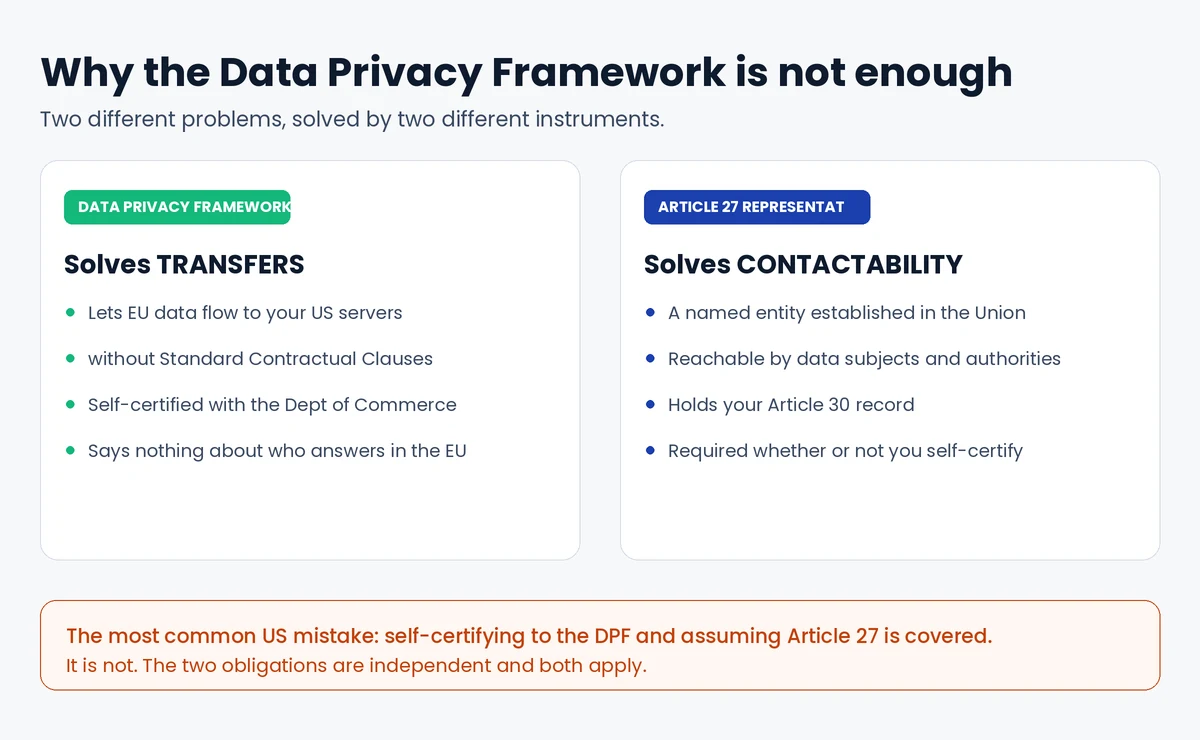
Governs the lawfulness of moving data to your US servers. Contains no obligation to have a contact point inside the Union, and the Department of Commerce is not one.
A contract between you and your counterparty. A data subject in Portugal is not a party to it and cannot write to it.
Built around residents of California, Virginia, Colorado and the rest. Different law, different subjects, different regulator.
Article 27(1) requires a designation in writing naming a specific entity. A paragraph promising compliance names nobody.
Article 3(2) has no revenue floor and no minimum number of European customers. These are the moments US companies typically cross the line without noticing.
| Before | After |
|---|---|
| No contact point in the Union | A named entity in Prague, addressable in eight languages |
| Privacy notice silent on Article 27 | Wording naming the representative, generated for each language your site uses |
| Article 30 record held only in the US | Held inside the Union and produced to an authority on request |
| Vendor questionnaires stall on the representative question | A certificate with a code the buyer can verify without contacting you |
| Exposure under Article 83(4)(a) | The standalone infringement removed |
Worth saying plainly, because some US providers blur it. A representative does not give legal advice, does not answer requests on the merits, does not negotiate with an authority for you, and cannot serve as your data protection officer — EDPB guidance treats those two roles as incompatible. We are the point of contact the regulation requires, performed properly, and nothing more.

No, and this is the most frequent misunderstanding among US companies. Self-certification with the Department of Commerce addresses transfers of personal data from the Union to the United States. Article 27 addresses whether someone inside the Union can be contacted by a data subject or an authority. Both apply independently.
Not at all. State privacy laws govern the personal information of residents of that state. The GDPR governs the personal data of people in the Union, and Article 27 asks for a representative established there. Programmes built for state law do not touch it.
Usually yes. Business contacts are personal data under the GDPR: names, work emails and phone numbers of employees at your European client companies all count. Being B2B changes who the data subjects are, not whether the regulation applies.
Probably not, if that subsidiary is a real establishment carrying out the processing. Article 27 applies only where you have no establishment in the Union. A registered shell with no staff and no activity does not qualify.
Up to $10 million equivalent or 2% of worldwide annual turnover under Article 83(4)(a), assessed against the group, not the US entity alone. In practice the more common cost is commercial: European buyers ask for the representative's name during vendor onboarding and stall the deal without it.
Anyone established in the Union can be designated if they accept the mandate in writing. Most distributors decline, because the role carries direct exposure to supervisory authorities and requires holding your Article 30 record on their premises.
The one where the complaining individual lives, not the one where your representative sits. A complaint from a Spanish customer is handled by the Spanish AEPD, which writes to the representative in whatever language it chooses.
The designation is issued within 24 hours of a completed onboarding form. The wording for your privacy notice comes with it, so the public part of the obligation is satisfied the same day.
Related: the Article 3(2) test · selling into Britain too? · what it costs
We read your public privacy notice and tell you in ten seconds whether a representative is named. If one is, we say so and you close the tab.
Run the free check See pricing