
Article 16 GPSR · own-store sellers
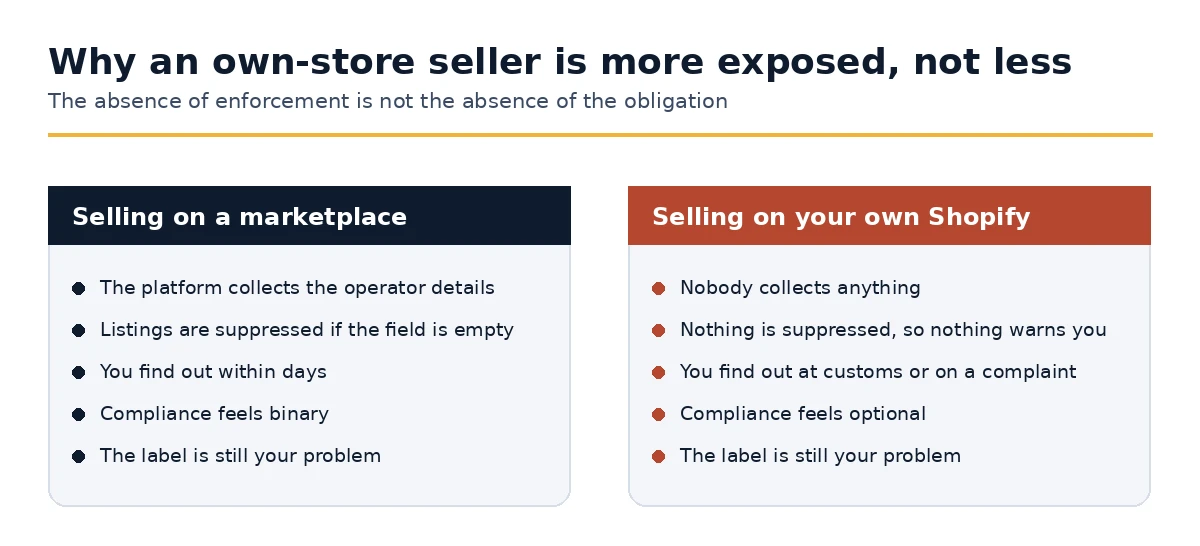
Marketplace sellers meet the GPSR through a suppression notice. Own-store sellers meet it at a customs hold, a consumer complaint or a wholesale buyer's audit — months later, with stock already sold. Nobody validates your Shopify theme against Article 16, and that absence of enforcement is the single reason own-store sellers are the least compliant group we deal with.
No suppressionCustomsComplaintsWholesale auditsReturns
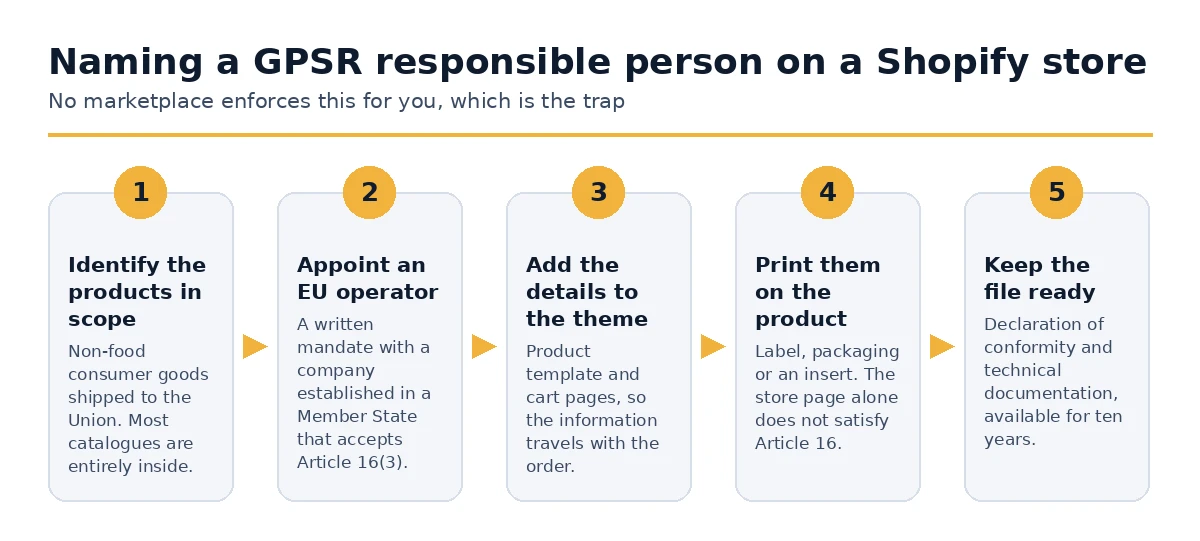
Step four is where own-store sellers fail. Adding the operator to a product template feels like completion, and it is only the part the customer reads before buying — not the part the inspector reads afterwards.
| Location | What goes there | Satisfies Article 16? |
|---|---|---|
| Product template | Operator name and EU address, safety warnings | Helps the buyer, not the inspector |
| Cart and checkout | A link to the safety information | No |
| A dedicated compliance page | Operator details, contact, warnings by language | No, but useful for buyers and auditors |
| The product itself | Name, trade name, postal address, identifier | Yes |
| Packaging or insert | The same details, durably printed | Yes |
Only the last two rows are the regulation. The first three are commerce, and they are worth doing because European buyers increasingly look for them before ordering from an unfamiliar store.
Europe Services, SE in Prague, printable on the product and publishable on the store.
Standard safety wording in the languages of the countries you ship to, so one artwork can serve several.
Declaration of conformity and technical file kept available to authorities for ten years.
Consumer and authority enquiries logged and forwarded to you the same working day.
For own-store sellers this question decides everything else, and the answer is usually less comfortable than expected.
| Arrangement | Manufacturer under the GPSR | Consequence |
|---|---|---|
| Own brand, made to your design | You | Risk assessment, technical file and conformity are yours |
| White label with your logo applied | You | Applying your name makes you the manufacturer |
| Third-party brand resold unchanged | The brand owner | You are a distributor, with lighter but real duties |
| Modified before sale | You | Substantial modification transfers the role |
| Handmade by you | You | Same duties, no volume exemption |
Beyond the label, there is a commercial reason to publish this properly: European consumers buying from an unfamiliar store increasingly check. A single page, linked from the footer, does the work.
Name and full EU address of the responsible person, with an email that is answered.
Warnings and instructions per product family, in the languages of the markets you ship to.
A line stating that declarations of conformity are available to authorities and to buyers who ask.
Where to report a problem with a product. Article 19 requires you to notify authorities of accidents through the Safety Business Gateway, and a reporting route is how you learn about them.
Artwork changes are cheap between runs and expensive afterwards. Fix the designation first, then add the operator details to the artwork, the packaging and the insert in one pass, rather than applying stickers to stock that has already shipped.
A European retailer buying from you will ask for the declaration of conformity, the responsible person details and the label proofs before the first purchase order, because it becomes a distributor with its own duties the moment it lists your product. Own-store sellers who prepare this for compliance reasons usually find it opens the wholesale channel as a side effect.
A request from a market surveillance authority is short and specific, and it arrives with a deadline measured in days rather than weeks. Knowing the order helps, because the first two items are the ones that take time to obtain from a manufacturer once the clock is running.
| Requested | Who produces it | Typical delay if missing |
|---|---|---|
| Declaration of conformity | Manufacturer, which for own brands is you | Weeks, if testing is needed |
| Test reports | An accredited laboratory | Weeks to months |
| Risk assessment | You, documented | Days |
| Label proofs | You or your printer | Hours |
| Sales volumes by market | Your store back office | Hours |


Because the check happens later and elsewhere: at customs, on a complaint, or when a European retailer audits you before a wholesale order. By then the stock is already sold.
No. Shopify is a platform, not an economic operator for your products, and it does not take on the Article 16 role in any plan.
Non-food consumer products, which covers most of what is sold on Shopify: apparel, homeware, electronics, tools, accessories. Medicines, medical devices and food have their own regimes.
The GPSR has no threshold for volume or craft production. Handmade consumer goods are consumer goods.
Then it may act as the responsible person for the products it makes, provided its details reach your buyer with the product. For imported goods, you need your own.
Almost never. A logistics provider gives you storage and shipping; Article 16(3) asks for documentation duties over ten years that no 3PL contract includes.
Yes. One Member State is enough to place the product on the EU market.
The obligation bites when goods are made available to a consumer. Stock in transit or in a warehouse can still be regularised with an insert before it ships.
No. It holds the documentation, answers authorities and supports corrective action. Conformity assessment and testing remain the manufacturer's responsibility, which for own-brand goods is you.
If you have EU customers, yes. That is a separate regulation, and on your own store you certainly do hold customer data.
We log the request, answer within the required time, pass on the documentation we hold, and forward everything to you the same day.
€290 a year for the responsible person alone, €890 for the Multi plan covering it together with the Article 27 GDPR representative.
Signed within 24 hours of a completed form; adding the details to the theme takes an afternoon, and the label change follows your next print run.
Related: what has to be printed · the GDPR side for Shopify
An Article 16 designation signed within 24 hours, with the exact label wording, warning translations and a certificate anyone can verify.
Appoint a responsible person