
REP27 · Processors
Article 27 GDPR · Processors
Processors are covered by Article 27 on exactly the same terms as controllers, and almost none of them know it. The assumption is that the client's designation covers the supply chain. It does not: a designation covers the entity that signed it, so a hosting provider, a support desk, an analytics vendor or a BPO operation outside the Union needs one of its own.
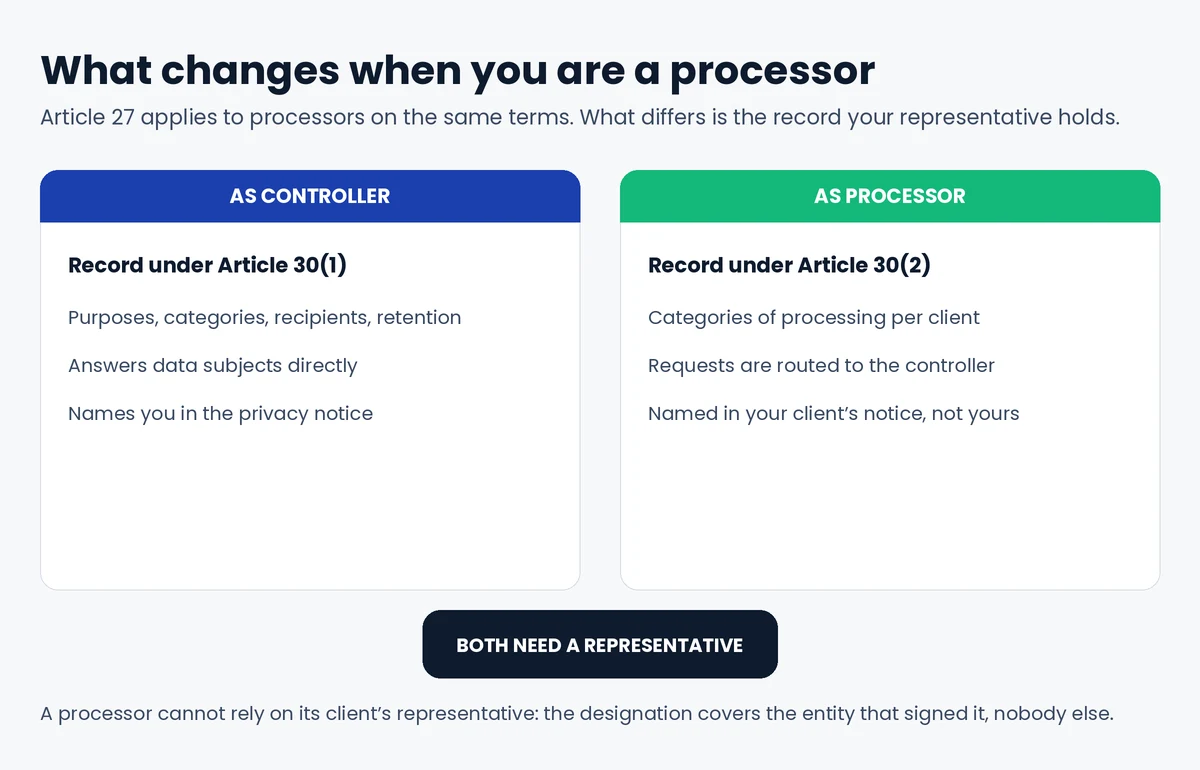
The obligation is identical; three practical things around it are not.
Article 30(2) rather than 30(1): categories of processing per controller, transfers, and a general description of security measures.
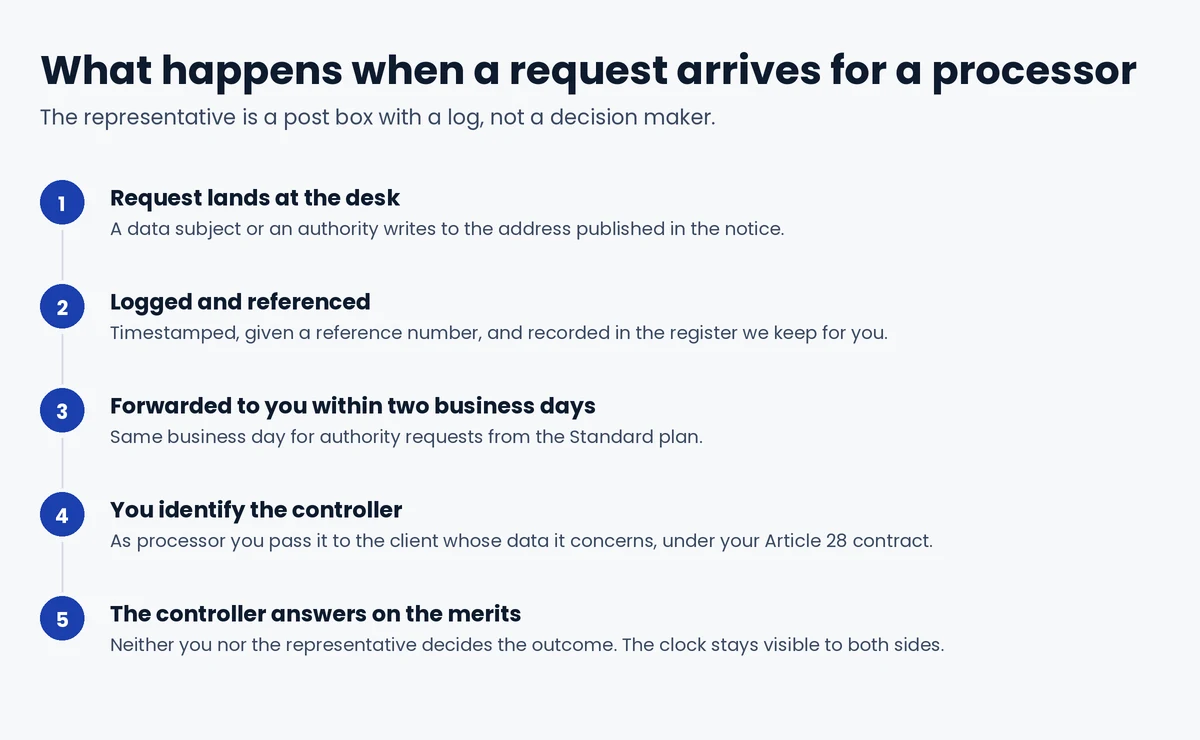
Requests reaching you are passed to the controller under your Article 28 contract, not answered by you.
You appear in your client's privacy notice, not in your own consumer-facing one — which is why the obligation is so easy to overlook.
Your client's procurement team, not a regulator, is usually the first to ask for the designation.
| Type of supplier | Role | Representative needed |
|---|---|---|
| Cloud hosting outside the EU | Processor | Yes |
| Outsourced customer support | Processor | Yes |
| Payroll or HR platform | Processor | Yes |
| Analytics vendor with user identifiers | Processor, sometimes joint controller | Yes |
| Sub-processor of the above | Processor | Yes |
| Supplier that never touches personal data | Neither | No |
European controllers have spent years mapping their processors. What almost nobody has mapped is whether those processors are themselves within Article 3(2) and, if so, whether they have a designation of their own.
The chain is usually longer than the contract suggests. A European retailer uses a US e-commerce platform, which uses a Canadian search vendor, which uses an Indian support desk. Each of the three is a processor or sub-processor established outside the Union, each processes personal data of people in the Union, and each needs its own representative. The retailer's designation covers the retailer, and nothing else.
This is starting to surface in due diligence. Article 28(1) requires controllers to use only processors providing sufficient guarantees, and the more sophisticated questionnaires now ask not only for your representative but for confirmation that your own sub-processors have one. Being able to answer that quickly is becoming a differentiator among suppliers competing for the same European account.
For a sub-processor the calculation is simple. The designation costs less than the time spent explaining its absence during a single procurement cycle.
Yes. Article 27(1) refers to controllers and processors alike, and EDPB Guidelines 3/2018 confirm it. A processor established outside the Union that processes personal data of people in the Union, on behalf of any client, must designate a representative of its own.
No. A designation covers the entity that signed it. Your client's representative was mandated by your client, has no relationship with you, and cannot answer for your processing. This is the single most common mistake we correct on processor files.
The record under Article 30(2): the categories of processing carried out on behalf of each controller, the transfers you make, and a general description of your security measures. Not the full controller record under Article 30(1).
The request is logged, referenced and forwarded to you, and you route it to the controller whose data it concerns under your Article 28 contract. Neither you nor the representative decides the outcome — the controller answers on the merits.
Not in principle. Sub-processors are processors, and the territorial test in Article 3(2) is applied to your own activity. In practice sub-processors are often the last in the chain to appoint, which is why enterprise buyers now ask about them explicitly.
No. Article 27(5) is explicit that designating a representative does not affect legal actions against the controller or processor itself. It creates a contact point, not a transfer of responsibility.
Increasingly, yes. European controllers are required under Article 28 to use only processors providing sufficient guarantees, and their vendor questionnaires now include the representative's name and address as a line item.
With the Article 30(2) record held inside the Union, so your clients' questionnaires stop stalling.
Appoint us