
REP27 · Data Act · Cloud switching
Chapter VI · data processing services · 12 January 2027
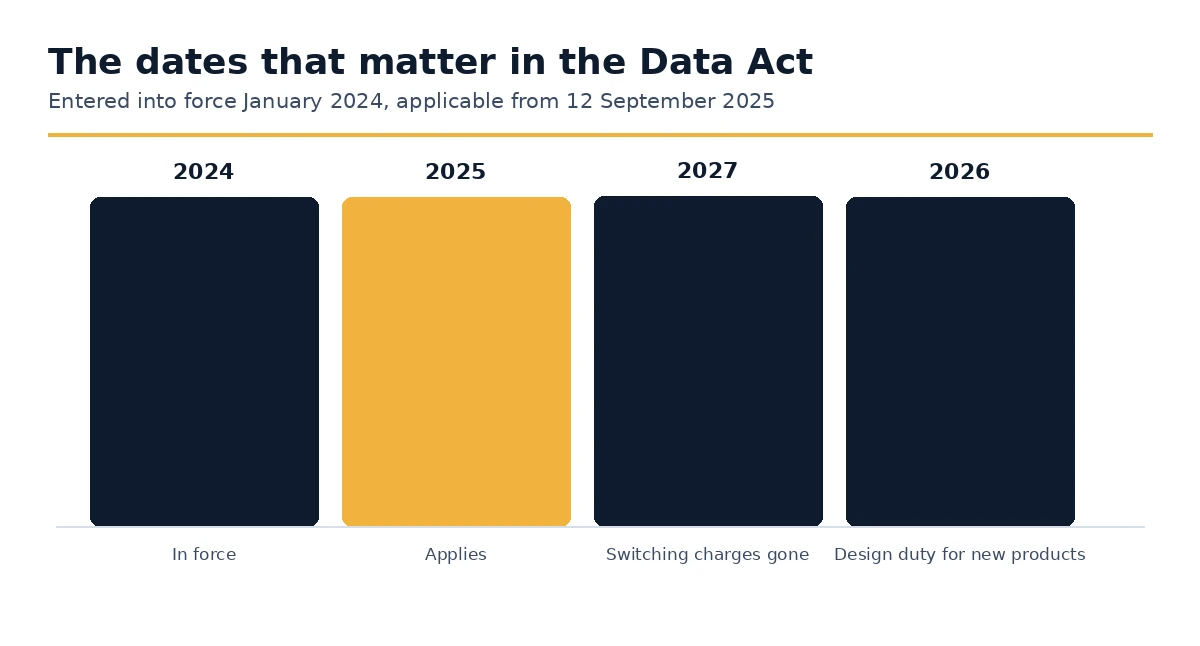
Chapter VI is the part of the Data Act that most changed how cloud is sold in Europe, and it applies to any provider of data processing services offering them in the Union, wherever the provider is established. Customers may switch to another provider or move on premise; obstacles have to be removed; notice periods are capped; transition periods are fixed; and switching charges disappear entirely on 12 January 2027. This page sets out the duties and the dates, and says which of them touch a provider based outside the Union.
SwitchingTwo months30 daysFunctional equivalence12 January 2027
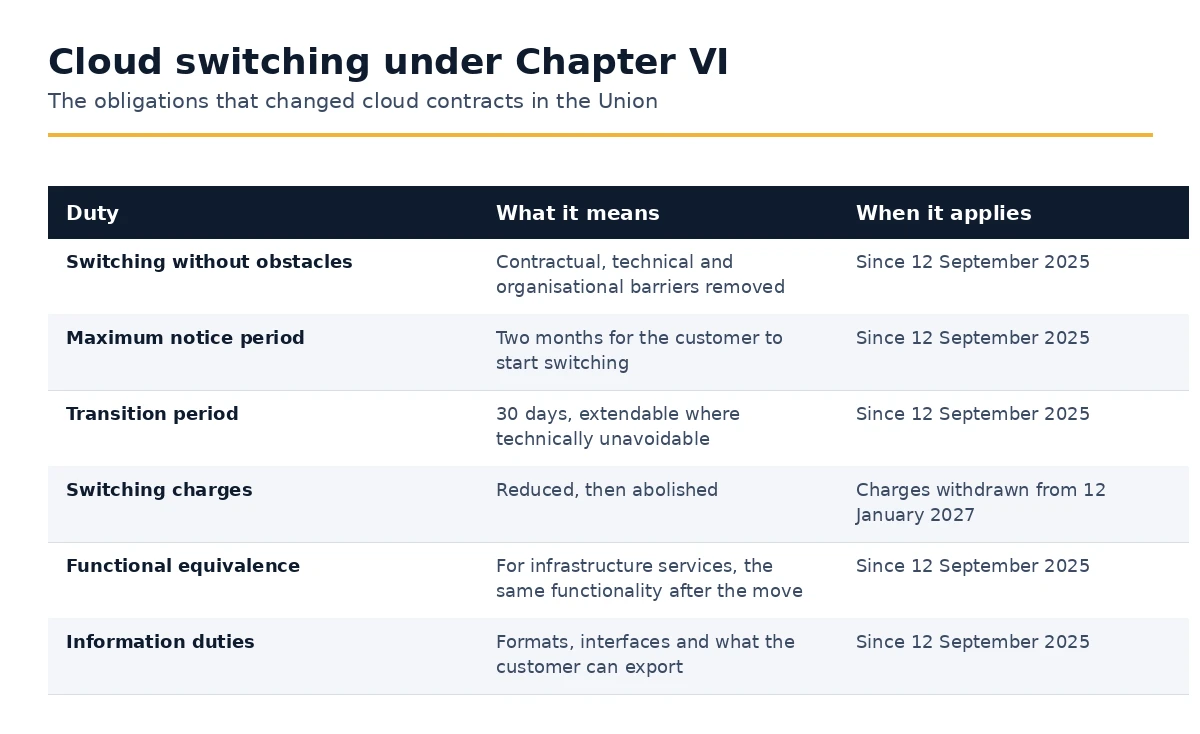
Everything in that table except the last line has applied since 12 September 2025. The charges line is the one with a future date, and it is the one that will change pricing models rather than paperwork.
Pre-commercial, commercial, technical, contractual and organisational barriers that stop a customer terminating, concluding a contract with another provider, porting their data and achieving functional equivalence.
A maximum notice period of two months for the customer to start the switching process, written into the contract.
A mandatory transition period of 30 days, extendable where technically unfeasible, during which the service continues and the move happens.
For infrastructure services, the customer should be able to re-establish a minimum level of functionality in the new environment. For other services, open interfaces and export.
Information duties: available formats, interfaces, documentation, what can be exported and how, before the contract and during it.
Erase exportable data and digital assets once the transition ends, at the customer's request.
| Provider | Chapter VI applies? | Representative needed? |
|---|---|---|
| EU provider selling in the EU | Yes | No, already established |
| Non-EU provider selling in the EU | Yes | Yes, no establishment in the Union |
| Non-EU provider selling only outside the EU | No | No |
| Reseller of another provider's service | Depends who provides the service to the customer | Follows the same test |
| On-premise software vendor | No, not a data processing service | Not for this chapter |
The second row is the one to sit with. A provider outside the Union selling cloud to European customers is caught by Chapter VI in full and, separately, has to appoint a representative under the regulation. Many are also caught by NIS2, because cloud computing is an Annex I service, and by Article 27 GDPR as a processor. Three regimes, one product.
Notice longer than two months for starting a switch no longer holds. Auto-renewal traps are the first thing customers now check.
Switching charges are being reduced and disappear on 12 January 2027. Pricing built on lock-in has a deadline.
Cooperation in good faith during the transition, not a paid professional services engagement invented at the end.
Formats, interfaces and export routes described in the contract or in referenced documentation, not discovered during the exit.
Erasure of exportable data and digital assets after the switch, on request, with confirmation.
Chapter IV's test on unilaterally imposed unfair terms applies across the contract, not only to the switching clauses.
Chapter VI is a commercial regulation dressed as a technical one. The compliance work is small; the pricing consequences are not, and they are the reason to look at it now rather than in late 2026.
| Question to answer internally | Why it matters |
|---|---|
| How much revenue depends on egress and exit fees? | That line disappears on 12 January 2027 |
| What is our longest notice period in force? | Anything above two months for starting a switch is unenforceable |
| Can a customer export everything without our help? | Documented formats and interfaces are the obligation |
| Do we have an exit runbook? | Thirty days is short if nobody has rehearsed it |
| Who receives a complaint from an EU customer? | If you are outside the Union, the representative |
Chapter VI has changed procurement conversations more than it has changed architectures. These are the questions arriving in European tenders, and having written answers is worth more than any certificate.
| Question in the tender | What a good answer contains |
|---|---|
| What is your maximum notice period? | Two months or less for starting a switch, quoted from the contract |
| What do you charge to leave? | Current reduced charges, and the confirmation that they end on 12 January 2027 |
| What formats can we export? | A list, with documentation links, not a promise to discuss it later |
| How long is the transition? | Thirty days, with the conditions for extension stated |
| Who is your representative in the Union? | An entity, an address and a verifiable certificate, if you are established outside |
| Will you delete our data afterwards? | Yes, on request, with confirmation |
Providers that answer all six in one page win time in the sales cycle. It is the same pattern as with the other European regimes: the regulation sets a floor, and the commercial advantage goes to whoever documents compliance before being asked.
Data, configurations, and the digital assets the customer brought or created. Written down per service, not per ticket.
Run it once against a real tenant. Thirty days is short if the first attempt is also the rehearsal.
Someone who owns the transition on your side, because a switch handled by nobody in particular is how deadlines slip.
Erasure of exportable data after the move, on request, with something in writing.
The contract clauses that reflect all of the above, so that the runbook and the agreement say the same thing.
Remove the obstacles, cap notice at two months, run a 30-day transition, deliver functional equivalence for infrastructure services, document the formats and interfaces, delete on request afterwards. Charges for switching are already limited to costs and disappear entirely on 12 January 2027, which is the date to plan pricing around. All of it applies to providers offering data processing services in the Union whatever their place of establishment, and a provider based outside the Union also needs a representative there, often alongside a NIS2 mandate and an Article 27 designation for the same product.
A provider outside the Union selling cloud services in Europe is rarely dealing with Chapter VI alone. Seeing the three together avoids solving the same problem three times with three suppliers.
| Regime | What it governs | Representative | Extra duty |
|---|---|---|---|
| Data Act Chapter VI | Switching, portability, charges | Yes, if not established in the Union | Contract and documentation changes |
| NIS2 | Security of the service, incident reporting | Yes, Article 26(3) | Entity registration, Article 21 measures |
| GDPR | Personal data processed for customers | Yes, Article 27, usually as processor | Article 28 contracts, records, breach notification |
Three mandates, three certificates, one renewal date if they sit with the same provider. The alternative, which we see often, is three suppliers renewing in different months, correspondence arriving at whichever desk the sender guessed, and an audit that takes a fortnight because nothing lines up.
Anything requiring more than two months before a customer can start switching is unenforceable in the Union. Find them before a customer does.
Model the revenue that disappears on 12 January 2027, and decide now whether it moves into base pricing or simply goes.
If the contract is vague, a customer can reasonably demand the formats your own systems use. Vagueness helps them, not you.
Exit support written as a chargeable service needs revisiting; cooperation during the transition is an obligation, not a product.
Chapter VI is unusual among European data rules because its target is commercial rather than protective. The Commission's concern was that customers of cloud services could not realistically leave, not because the technology prevented it but because contracts, egress pricing and undocumented formats made the exercise expensive enough to abandon. The remedy is procedural: cap the notice, fix the transition, document the formats, remove the charges, and let competition do the rest. Whether that produces more switching is an open question; what it has already produced is a market where the ability to leave is a purchasing criterion, stated in tenders and scored.
For a provider that never relied on lock-in, the compliance work is a fortnight of contract and documentation changes and no revenue impact at all. For a provider whose margins depend on egress, the deadline in January 2027 is a pricing project rather than a legal one, and it needs a year rather than a month. Knowing which of the two you are is the first decision, and it is usually finance rather than legal who can answer it.
A provider outside the Union selling cloud into Europe is usually caught by three different European instruments at once. They are separate, they are cumulative, and each has its own mandate.
| Instrument | What it governs | Mandate | Where it shows |
|---|---|---|---|
| Data Act, Chapter VI | Switching, notice, transition, charges | Data Act representative | Contracts and documentation |
| NIS2, Annex I | Security of the service, incident reporting | NIS2 representative | Entity registration |
| GDPR, Article 28 | Processing customer personal data | Article 27 representative | Privacy notice and DPA |
Enterprise buyers in Europe now ask about all three in the same questionnaire, and a provider who answers with three certificates and one contact address closes those reviews in days. It is the least glamorous competitive advantage available in this market and one of the most reliable.
Signed within 24 hours by Europe Services, SE in Prague, naming us as your representative under the regulation.
With a code your customers can check without contacting you, which is what unblocks procurement.
Customer and authority correspondence logged the day it arrives, answered procedurally, forwarded to you the same working day in eight languages.
What you give us stays available for as long as the mandate runs.
NIS2 and Article 27 on the same renewal date, so nothing lapses quietly in a month nobody watched.
Rewrite your contracts, build your export tooling, price your egress or advise on national implementing measures.
Chapter VI applies wherever the service is offered in the Union, whoever provides it. Two months maximum notice to start a switch, a 30-day transition, obstacles removed, functional equivalence for infrastructure services, information duties on formats and interfaces, and switching charges gone entirely on 12 January 2027. If you are outside the Union you also need the representative, and if you provide cloud computing you are almost certainly an Annex I entity under NIS2 as well.


Yes, where the service is offered to customers in the Union. Establishment changes whether you need a representative, not whether the switching rules apply.
Two months for the customer to start the switching process.
Thirty days, extendable where the move is technically unfeasible in that time.
Charges are withdrawn from 12 January 2027. Until then they are reduced and must not exceed the costs incurred.
Re-establishing, in the new environment, a minimum level of functionality equivalent to the original service. It applies to infrastructure services.
Yes, as a data processing service, with the obligations adjusted: open interfaces and export rather than full functional equivalence.
Yes, cooperate in good faith and make the switch effective. Charging for that assistance stops in January 2027.
Minimum terms are not banned outright, but obstacles to switching are, and any notice beyond two months for starting the process does not hold.
Available formats, interfaces, documentation, what is exportable and how, before the contract and during it.
Yes, exportable data and digital assets, on the customer's request, once the transition ends.
The switching chapter is aimed at customers of data processing services, which are typically businesses, but the fair terms rules reach further.
They apply together. NIS2 governs security and requires its own representative; Chapter VI governs switching.
If no entity of yours is established in the Union, yes.
Set by Member States, effective, proportionate and dissuasive, with national authorities designated to enforce.
Article 32 requires safeguards against unlawful third-country government access to non-personal data held in the Union. That is separate from switching.
The rules bite where the service is offered in the Union. A non-EU customer of a non-EU provider is outside.
Within 24 hours of the intake call, with a certificate carrying a verification code.
Contract redrafting, exit engineering, pricing decisions and legal advice on national implementing measures.
Related: the representative mandate · NIS2 for cloud providers
Europe Services, SE in Prague as your Data Act representative, with correspondence from customers and authorities logged and forwarded the same working day.
Request this service